TL;DR: Non-compete clauses remain one of the most powerful, and most contested, tools in restrictive covenant practice. The FTC's 2024 ban upended assumptions, but federal litigation has left enforceability in limbo, returning power to state law. California still voids nearly all non-competes; Texas and Florida enforce them aggressively. The practical takeaway: draft narrowly (12-24 months, real geography or customer-list scope), include garden leave for consideration, build in severability so your NDA and non-solicitation survive even if the non-compete falls, and always check the law of the state where enforcement would actually occur. If you are advising on an M&A deal, the calculus is different: sale-of-business non-competes enjoy broader enforceability in almost every jurisdiction.
The non-compete clause has long anchored confidentiality and trade secret protection regimes, particularly in employment and M&A contexts. But 2024 shifted the terrain significantly. The Federal Trade Commission's final rule banning most employer non-competes (16 CFR Part 910) took effect January 5, 2024, though immediate litigation ensued. As of early 2026, multiple federal courts have enjoined enforcement of the rule, returning control to state legislatures and courts. This patchwork creates a drafting nightmare: a provision that shields a Boston tech founder from competition might be unenforceable if that founder relocates to California, but iron-clad in Texas or Florida.
The enforceability doctrine pivots on the reasonableness test, which examines duration, geographic scope, and scope of restricted activities. Courts balance the employer's legitimate interest in protecting trade secrets and customer relationships against the employee's right to earn a livelihood. The "blue-pencil" doctrine-a judge's power to narrow an overbroad clause-varies dramatically by state. Some jurisdictions refuse reformation entirely; others rewrite clauses with surgical precision. Garden leave provisions (paying the employee during the restriction period) don't legally require acceptance but improve enforceability significantly by addressing consideration defects.
Remote work and AI adoption have complicated geographic reasonableness arguments. Can a software engineer working from rural Montana for a San Francisco fintech be restricted from competing "within 100 miles of company headquarters"? Courts are split. Similarly, the rise of generative AI raises questions about whether customer lists or methodologies fed into LLMs violate non-compete terms. These edge cases are still percolating through litigation.
Key considerations for non-compete clauses:
• Time period: 6-24 months typically survives scrutiny; 3+ years faces presumptive invalidity
• Geography: Must reflect actual operating footprint; "entire U.S." fails unless business is nationwide
• Scope: Restrict specific competitors, products, or customers-not all economic activity
• Consideration: Essential for existing employees; new hire status may suffice, but post-employment additions require extra consideration
• State-specific law: California bans nearly all non-competes (Cal. Bus. Code § 16600); Texas enforces narrowly tailored restrictions aggressively
Core Concepts: Reasonableness and Trade Secret Protection
- The Reasonableness Doctrine: Courts assess non-competes against a three-part test: (1) Is there a legitimate protectable interest? (2) Is the restriction reasonable in time, territory, and line of business? (3) Does the restriction impose undue hardship on the employee and harm the public? Employer interests include trade secrets, confidential business information, customer goodwill, and substantial relationships formed through employment. The employee's interest in pursuing a livelihood carries significant weight, especially post-employment. Public policy disfavors forfeiture of livelihood rights.
- Geography and Scope in the Remote Work Era: A 100-mile radius restriction made sense when employees worked in a physical office. Today, a remote engineer might serve customers across three continents from a home office in Wisconsin. Drafters must specify whether geographic limits apply to the employee's location, the employer's location, the customer's location, or some combination. Technology companies increasingly use customer-list restrictions (e.g., "any customer with whom employee had contact during employment") instead of geographic proxies. This approach sidesteps the remote work problem but invites disputes about who counts as a customer and what level of contact triggers the restriction.
Duration, Industry, and the Tiered Approach
- Temporal Reasonableness: Consensus holds that 1-2 years is reasonable for most roles; 3+ years faces judicial skepticism unless the employer establishes extraordinary trade secret or customer relationship interests. Industries with rapid innovation cycles (software, biotech) sometimes justify 2-3 year windows; mature industries with stable customer bases defend shorter periods. The FTC's 2024 rule, before litigation paused it, targeted duration as a chief concern-the proposed rule would have permitted non-competes only for genuine sale-of-business scenarios.
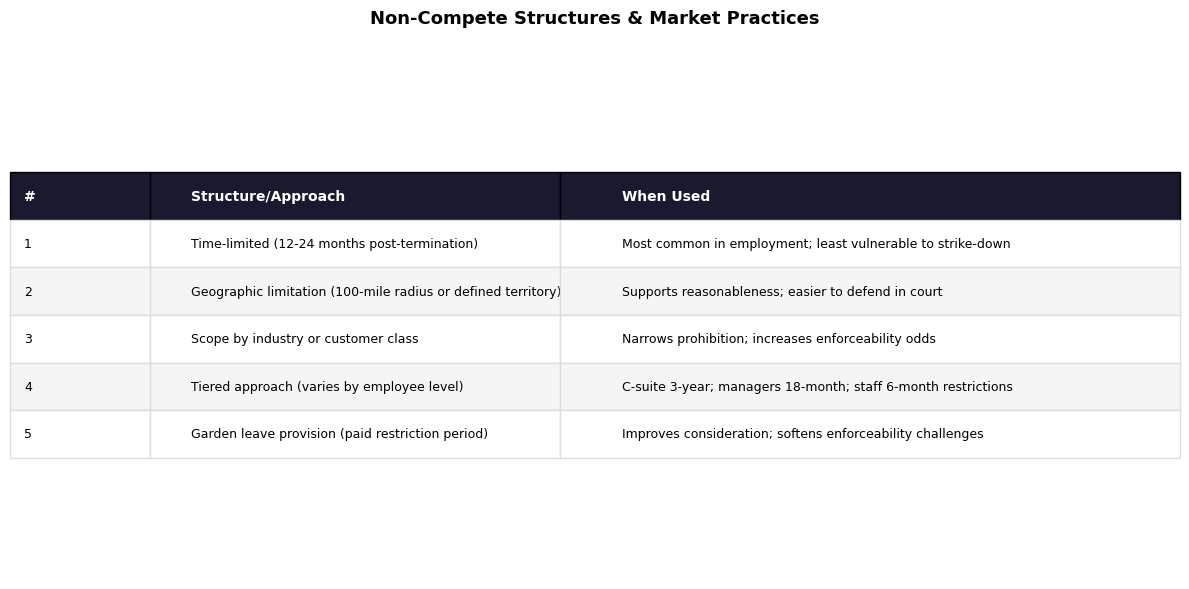
- Tiered Structures and Blue-Pencil Risk: Many employers draft tiered non-competes: executives face 3-year global restrictions; managers face 18-month regional restrictions; individual contributors face 6-month local restrictions. This approach demonstrates reasonableness by context. However, it creates severability headaches. If the court strikes down the executive tier as overbroad, does the entire clause fail, or do lower tiers survive? Smart drafting includes explicit severability language stating that each tier stands independently.
A well-drafted Non-Compete Clause contains:
- Clear Definition of Restricted Activity: Specify precisely what the employee cannot do. Example: "employee shall not directly or indirectly solicit, service, or accept business from any customer with whom company had business relationships during the twelve months preceding termination" is better than "employee shall not compete." The narrower language survives scrutiny and provides employees fair notice.
- Temporal Limitation Tied to Legitimate Interest: State "For a period of [12/18/24] months following termination of employment, employee shall not engage in Restricted Activity." Connect this to a specific protectable interest: "to protect company's trade secrets and customer relationships." This narrative supports reasonableness arguments.
- Geographic Scope with Rationale: Specify "within the geographic territory where company conducted business as of the termination date," and if possible, attach an exhibit listing specific cities, regions, or territories. Avoid blanket national or worldwide restrictions unless the company genuinely operates globally. For remote-first companies, consider customer-based or product-based scope instead.
- Consideration Clause for Existing Employees: Include language like "In consideration for the promises herein, employer agrees to [continued employment / promotion / raise / garden leave]. Employee acknowledges this constitutes independent, valuable consideration beyond continued employment." This addresses the critical enforceability requirement that consideration be bargained-for at the time of the restriction's imposition.
- Blue-Pencil and Severability Language: State: "If any portion of this Non-Compete is found unenforceable, the parties request that a court of competent jurisdiction reform this clause to the maximum extent permitted by applicable law and enforce the reformed version." Check your jurisdiction's stance on reformation; some courts honor this language, others ignore it. Include a severability clause making sure that if the non-compete fails entirely, other restrictive covenants (NDA, non-solicitation) survive.
- State Law and Dispute Resolution: Specify governing law: "This Non-Compete shall be governed by the laws of [State], without regard to conflict of law principles." Be aware that California courts will strike non-competes regardless of choice-of-law language. For multistate employers, consider "The substantive provisions shall be governed by [State X], but enforceability questions shall be determined under the law of the jurisdiction where enforcement is sought." This hybrid approach can help.
- Return and Destruction of Confidential Materials and Restrictive Covenant Independence: Include: "Upon termination, employee shall return all company property and confidential information. This Non-Compete is independent of and shall not be waived or modified by [non-solicitation / NDA] provisions." This separates the restrictive covenants and ensures that a court striking down the non-compete does not kill the NDA or non-solicitation clause.
Market Position & Benchmarks
Where Does Your Clause Fall?
- Employee-Favorable: 6-12 month duration, narrow activity scope (named competitors only), customer-list restriction instead of geographic scope, garden leave at full salary, automatic expiration if terminated without cause, no reformation clause (clause fails entirely if overbroad).
- Market Standard: 12-18 month duration, moderate geographic scope (metro area or state) or customer-list restriction, partial garden leave (50-75% salary), blue-pencil/reformation language, explicit severability from NDA and non-solicitation, consideration tied to initial employment or promotion.
- Employer-Protective: 18-24 month duration (up to 36 months for executives or M&A sellers), broad geographic scope (national or global for senior roles), activity and customer restrictions combined, liquidated damages plus injunctive relief, tolling provision (restriction period paused during breach), no automatic expiration on termination without cause.
Market Data
- Approximately 18% of U.S. workers are currently bound by a non-compete clause, down from an estimated 30 million workers pre-2024 FTC rulemaking activity (U.S. Treasury, Economic Policy Institute data).
- Median non-compete duration in employment agreements is 12 months; M&A sale-of-business non-competes average 24-36 months with broader geographic scope.
- States with outright or near-total bans on employment non-competes: California, Minnesota, North Dakota, Oklahoma. States with income-threshold restrictions (non-competes unenforceable below a salary floor): Colorado ($123,750+), Illinois ($75,000+), Oregon ($113,241+), Washington ($116,593+).
- Garden leave provisions appear in roughly 15-20% of negotiated executive non-competes in the U.S., compared with over 60% in the U.K. where garden leave is the dominant restrictive mechanism.
- Blue-pencil or judicial reformation is permitted in approximately 30 states; the remainder follow the "all-or-nothing" rule where an overbroad non-compete is struck entirely.
- Post-2024, litigation challenging non-competes has increased an estimated 35-40% year-over-year, with employees increasingly filing preemptive declaratory judgment actions to void restrictions before starting new employment.
Sample Language by Position
Employee-Favorable: "For a period of six (6) months following termination of Employee's employment for any reason, Employee shall not accept employment with any entity listed on Exhibit A (Direct Competitors). This restriction applies only to roles substantially similar to Employee's position with Company. Company shall pay Employee 100% of base salary during the restriction period as garden leave. If Employee is terminated without Cause, this restriction shall not apply."
Market Standard: "For twelve (12) months following termination of employment, Employee shall not, directly or indirectly, engage in Restricted Activity within the Territory. 'Restricted Activity' means providing services substantially similar to those Employee performed for Company to any Covered Customer or Direct Competitor. 'Territory' means the metropolitan statistical areas in which Company conducts business as of Employee's termination date. If any court finds this restriction overbroad, Company and Employee consent to reformation to the maximum extent permitted by law."
Employer-Protective (M&A): "For twenty-four (24) months following Closing, Seller shall not, directly or indirectly, own, manage, operate, control, or participate in any business that competes with the Acquired Business anywhere in the United States and Canada. 'Compete' means offering products or services substantially similar to those offered by the Acquired Business as of the Closing Date. The restriction period shall be tolled during any period of Seller's breach. Seller acknowledges that violation will cause irreparable harm entitling Buyer to injunctive relief without bond, plus liquidated damages of $[amount] per month of breach."
Example language:
Here are two approaches reflecting different risk tolerances and party positions:
- Construction Contract (narrow, employee-favorable): "For twelve months following termination of employment, Contractor shall not directly or indirectly engage in any construction services for commercial real estate projects involving clients of Company in the three-county metropolitan area where Contractor worked during employment, provided that this restriction shall not apply to projects Contractor initiated independently prior to termination or to clients Contractor did not contact or serve during Contractor's tenure."
Example: "During the term of employment and for a period of twelve (12) months thereafter, Employee shall not, directly or indirectly, engage in any business that competes with the Company's business in any geographic area in which Company conducts business as of Employee's termination date. Employee acknowledges that Company's legitimate business interests include trade secrets and confidential information, established customer relationships, and substantial relationships of personal trust. The scope of this restriction shall be limited to customers with whom Employee had contact during the twelve-month period preceding termination. In the event a court determines any provision of this restriction overbroad, Company and Employee consent to reformation of this clause to the maximum extent allowed by law."
- Technology/SaaS License Agreement (broader, licensor-protective): "For eighteen months following expiration or termination of this Agreement, Licensee shall not develop, market, or license products or services that compete directly with the Licensed Software in the North American market. Competition is defined as offering substantially similar functionality to [specific feature set]. This restriction applies to any materials, code, or methodologies derived from Licensor's Confidential Information, regardless of whether such materials remain proprietary post-termination."
Example: "For a period of eighteen (18) months following the Closing, Seller covenants that Seller shall not, directly or indirectly (whether as owner, partner, manager, consultant, or otherwise), engage in or have any interest in any business competitive with the Purchased Business within the Territory (defined as the United States and Canada). Competitive Business means any business that derives revenue from [specific services listed]. Seller acknowledges that this covenant is essential to Buyer's acquisition and is subject to reformation if a court deems it unreasonable in time or territory. Seller's violation of this covenant will result in liquidated damages of [amount] per breach, in addition to injunctive relief. Seller shall receive Garden Leave of [amount] per month during the restriction period as independent consideration."
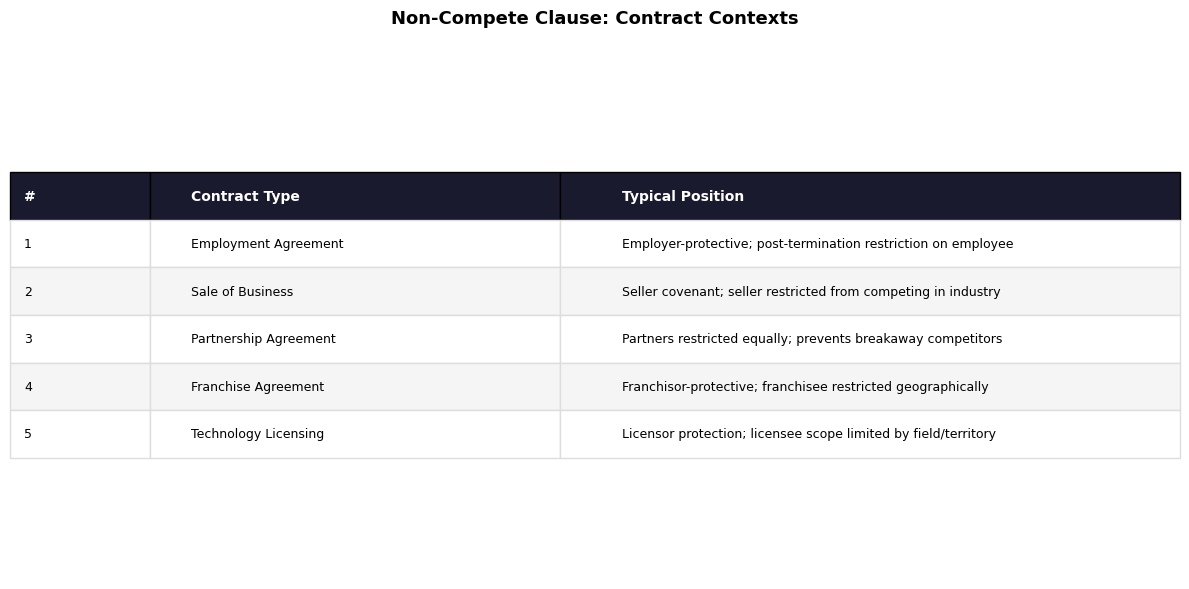
Contract types where Non-Compete Clause is critical:
Common structures and market practices:
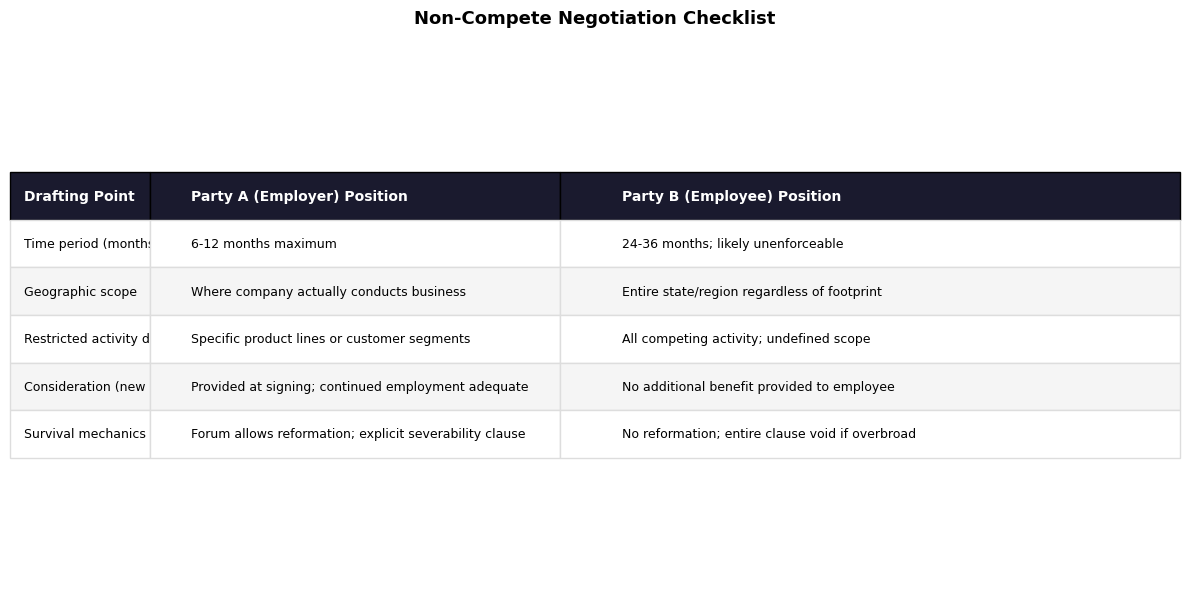
Negotiation Playbook
Key Drafting Notes
- Always tie the restriction to a named protectable interest. Courts increasingly require employers to articulate exactly what they are protecting: trade secrets, customer relationships, specialized training investments, or confidential business strategies. A non-compete that merely says "to protect Company's business" without specifying the interest is vulnerable to challenge. Name the interest in the recitals and in the operative clause.
- Layer your restrictive covenants defensively. Assume the non-compete may be struck. Draft the NDA, non-solicitation of customers, and non-solicitation of employees as independent, severable obligations. If the non-compete falls, your client still has meaningful protection through the surviving covenants. This layered approach is now standard practice in jurisdictions where non-compete enforceability is uncertain.
- Use garden leave to solve the consideration problem. For mid-career hires and existing employees asked to sign a new non-compete, continued employment may not constitute sufficient consideration in all jurisdictions. A garden leave payment (even a modest stipend) provides clear, independent consideration and signals good faith to courts evaluating reasonableness.
- Draft with the enforcement jurisdiction in mind, not the choice-of-law clause. California courts will void a non-compete governed by Texas law if the employee lives and works in California. The practical enforceability of your clause depends on where the employee is located and where you would seek an injunction. For multistate workforces, use jurisdiction-specific schedules rather than a single nationwide clause.
- Include a tolling provision for M&A non-competes. In sale-of-business contexts, add language stating that the restriction period is tolled during any period of the seller's breach. Without tolling, a seller who breaches on day one and litigates for 18 months effectively runs out the clock on a 24-month restriction.
Common Pitfalls
- Failing to provide fresh consideration for existing employees. Asking a current employee to sign a non-compete without new consideration (promotion, raise, bonus, garden leave) renders the clause unenforceable in many jurisdictions. "Continued employment" is insufficient consideration in at least 10 states. Always pair the new obligation with a tangible benefit.
- Relying on a geographic radius when the workforce is remote. A "50-mile radius from Company headquarters" restriction is meaningless for an employee who works from home in a different state and serves customers nationwide. Courts have increasingly declined to enforce geographic restrictions that bear no relationship to the employee's actual work. Use customer-list or product-line restrictions instead.
- Overreaching on scope and triggering the all-or-nothing rule. In states that do not permit judicial reformation (e.g., Virginia, Nebraska), an overbroad non-compete is void in its entirety. Drafting a 36-month, nationwide, all-activity restriction in an all-or-nothing jurisdiction means you get zero protection. Research the blue-pencil rules of the enforcement state before drafting.
- Ignoring the FTC rule's current status. While the 2024 FTC ban is currently enjoined, it has not been vacated. Employers who draft non-competes as if the rule does not exist risk having those clauses challenged under the rule if injunctions are lifted. Defensive drafting (narrower scope, garden leave, explicit trade-secret rationale) protects against both state-law and potential federal challenges.
- Omitting a carve-out for involuntary termination. Courts view non-competes more skeptically when the employer fired the employee and then seeks to restrict their livelihood. Including language that narrows or eliminates the restriction upon termination without cause demonstrates reasonableness and reduces litigation risk.
Key drafting notes for a Non-Compete Clause:
- The FTC Ban Uncertainty: As of 2026, the FTC's January 2024 non-compete ban is partially enjoined in multiple federal courts. Assume it may be vacated entirely or upheld. Draft non-competes defensively: narrower temporal and geographic scope, explicit trade-secret or customer-relationship protection narratives, and garden leave provisions improve odds regardless of which legal regime emerges.
- California and State-Specific Complications: California generally voids non-competes under Bus. Code § 16600, with narrow exceptions (sale of business, dissolution of partnership). If your company has California employees or expands to California, assume non-competes are unenforceable for those personnel. Use non-solicitation and NDA language instead. Conversely, Texas and Florida enforce narrowly tailored restrictions aggressively, so employer-protective language is warranted in those states.
- Remote Work and Geographic Scope: A 50-mile radius restriction is meaningless if the employee works remotely and serves clients nationwide. Consider substituting customer-list restrictions, product-line restrictions, or industry-specific restrictions. Example: "Employee shall not provide advisory services in climate tech to any Covered Client within 24 months of termination." This avoids geographic nonsense while protecting the employer's actual business interests.
- Garden Leave and Consideration: Offering salary or stipend payments during the restriction period (garden leave) significantly improves enforceability and reduces litigation risk. Courts view garden leave as a proxy for adequate consideration and as an employer good-faith concession to the employee's livelihood interests. A $5,000/month garden leave payment for a 12-month restriction on a mid-level employee is table stakes in competitive markets.
- Integration with Other Covenants: Non-competes work best as part of an integrated package: NDA (protecting information assets), non-solicitation of employees and customers (protecting relationships), and non-disparagement (protecting reputation). Courts often excuse non-compete strikes if the NDA and non-solicitation remain enforceable. Draft explicit severability: "If the Non-Compete is unenforceable, the Non-Solicitation and NDA survive in full force."
Historic note:
Non-competes emerged from English common law, where courts enforced covenants in restraint of trade only if they were "in reasonable restraint." The doctrine traveled to America, where state courts fragmented its application. By the 1980s-2010s, non-competes became ubiquitous in employment, particularly in technology and finance sectors. The post-2008 financial crisis and rise of the gig economy sparked growing skepticism; states like California and Illinois tightened enforcement. By 2020, the COVID-19 pandemic and remote-work shift exposed the absurdity of geographic restrictions, accelerating regulatory skepticism. The Biden FTC's 2024 ban represented the culmination of this trend, though litigation may reverse or substantially limit it by 2027-2028.
Jurisdiction specific notes:
- U.S. Jurisdictions: Enforceability maps directly to state law. California (Business Code § 16600) strikes nearly all non-competes except sale-of-business and partnership dissolution contexts. Texas applies a "legitimate business interest" test and enforces narrowly tailored restrictions. Florida, Delaware, and Georgia enforce aggressively. New York requires a "legitimate protectable interest" and balances reasonableness but is more forgiving than California. Federal courts in the Ninth Circuit (California-heavy) are skeptical; Fifth Circuit (Texas-heavy) is deferential. Always research the specific venue where enforcement would occur, not just where the parties' principal offices sit.
- U.K. Jurisdictions: English law applies a "legitimate proprietary interest" test similar to U.S. doctrine, but courts impose an additional public-policy gloss: restraints must not be anti-competitive. Restrictions covering "customer goodwill" are enforceable if reasonably tailored; restrictions on mere freedom to earn a livelihood fail. Garden leave is better accepted in UK practice, with UK employers commonly providing garden leave as the primary restrictive mechanism (e.g., 12 months paid garden leave with a 6-month non-compete) rather than relying on non-competes alone.
Drafting Tip:
For multistate or cross-border engagements, avoid drafting a single non-compete clause. Instead, draft jurisdiction-specific schedules. Example: "Schedule A applies to Employees in California (limited non-solicitation only). Schedule B applies to Employees in Texas (non-compete 12 months, 100-mile radius, plus non-solicitation). Schedule C applies to UK employees (6-month garden leave plus 6-month non-solicitation)." This surgical approach reduces litigation risk and demonstrates good-faith jurisdiction-specific reasonableness tailoring.
Bottomline:
Non-compete clauses remain valuable for protecting trade secrets, customer relationships, and confidential business information in M&A, employment, and licensing contexts. However, enforceability is fractured by jurisdiction, and the 2024 FTC rule (though partially enjoined) has shifted enforcement assumptions. Draft narrowly: specify duration (12-24 months maximum), geographic scope tied to actual business operations or customer lists, and scope of restricted activity with precision. Include garden leave and explicit consideration language, particularly for existing employees. Segment non-competes by jurisdiction and role tier to maximize reasonableness arguments. Integrate non-competes with stronger protective covenants (non-solicitation, NDA) that remain enforceable even if the non-compete fails. For California and states following similar anti-restraint-of-trade doctrines, default to non-solicitation and NDA as primary protective tools, reserving non-competes for M&A closings. Monitor 2026-2027 litigation outcomes on the FTC rule; judicial decisions will clarify the post-ban environment.
.avif)