TL;DR: Non-solicitation has become the centerpiece of restrictive covenant strategy in the post-FTC era. With non-competes increasingly unenforceable or legally uncertain, a well-drafted non-solicitation clause is often the strongest protection an employer can deploy. The key is precision: define exactly what solicitation means (including LinkedIn messages, third-party introductions, and social media outreach), identify covered employees and customers by name or objective criteria, carve out passive activity so courts see the restriction as targeted rather than overbroad, and include liquidated damages so enforcement does not depend on proving speculative harm. Employee non-solicitation and customer non-solicitation have distinct enforceability profiles; draft them as separate obligations with independent survival language.
Non-solicitation clauses have emerged as the muscular alternative to non-competes in post-2024 practice. The FTC's January 2024 rule curtailing broad non-competes, coupled with growing state skepticism of geographic restrictions and duration limits, has shifted employer focus toward non-solicitation provisions. These clauses restrict the employee's right to recruit colleagues or approach customers but do not restrict the employee from competing per se. The distinction matters profoundly for enforceability: courts view non-solicitation as a narrower, more targeted restraint on conduct (solicitation) rather than a blanket restriction on livelihood (competition). This doctrinal gap has made non-solicitation increasingly defensible even in skeptical jurisdictions like California, where courts have enforced narrow non-solicitation clauses while striking non-competes.
The real challenge is defining solicitation in an era of remote work, LinkedIn, and distributed teams. The blunt common-law definition-"directly approaching or inducing"-breaks down when an employee connects with former colleagues via social media, receives an unsolicited inquiry from a customer who found them online, or helps a former client via third-party introduction. Drafters face two competing pressures: breadth (to capture indirect channels like LinkedIn) and reasonableness (to avoid overreach that triggers unenforceability). The rise of talent-acquisition software, AI-powered recruitment tools, and social media hiring has forced drafters to confront what solicitation means in practice. Does posting an open job on LinkedIn to a broad audience constitute solicitation? Does responding to an unsolicited customer inquiry violate the clause? These questions lack settled answers, generating litigation risk.
The post-Great Resignation talent war has intensified non-solicitation negotiation. Employer leverage has weakened; talented employees command premium offers that include relaxed restrictive covenants. In competitive markets (technology, finance, professional services), companies increasingly accept narrower non-solicitation windows (6-12 months instead of 24 months), customer-list-only restrictions (no employee non-solicitation), or explicit carve-outs for passive recruitment (employees can list themselves publicly; employer cannot actively recruit). The trade-off reflects economic reality: companies want to retain talent, not litigate restrictive covenants.
Key considerations for non-solicitation clauses:
• Scope definition: Employee-only, customer-only, or hybrid; social media is NOT passive (requires explicit carve-out)
• Duration: 12-24 months enforceable; 36+ months faces skepticism even in pro-employer jurisdictions
• Covered relationships: Must define who qualifies (direct reports, customers with $X+ annual spend, etc.)
• Solicitation definition: Clarify whether passive referrals, LinkedIn connections, or third-party introductions trigger the clause
• Remedy structure: Liquidated damages improve enforceability; purely injunctive relief may fail if actual damages are speculative
• Enforceability post-non-compete: Non-solicitation survives even if non-compete is struck, providing fallback protection
Employee vs Customer Non-Solicitation: Distinct Enforceability Profiles
- Employee Non-Solicitation: Restricts the departing employee from recruiting or hiring colleagues, direct reports, or team members for a specified period. Courts increasingly accept these as narrowly tailored restraints on the employee's recruitment conduct, distinct from non-competes. The rationale: the employer has legitimate interests in protecting investment in team formation, avoiding disruption, and preserving institutional knowledge. However, courts scrutinize overly broad employee non-solicitation clauses that bar employees from working with anyone they knew during employment, as this bleeds into non-compete territory. A tight employee non-solicitation-covering only direct reports or specific teams-is more defensible than a sweeping "any employee known during tenure" provision. The seven-state Silicon Valley non-compete-ban coalition (California, Nevada, North Carolina, Oklahoma, Georgia, Florida early cases) has softened on employee non-solicitation, viewing it as less offensive to public policy than non-competes.
- Customer Non-Solicitation: Restricts the departing employee, contractor, or seller from soliciting or servicing customers of the employer/buyer for a specified period. These are generally enforceable even in restrictive jurisdictions because they target a specific, identifiable group (customers) and prevent the solicitor from using confidential customer information, pricing data, or vendor relationships obtained during employment. Courts reason that the employer's interest in customer loyalty and protection of investment in customer relationships is "legitimate and protectable." Customer non-solicitation is narrower than non-compete and more durable. A customer list properly defined (e.g., "customers with whom employee had material contact during employment" or "customers generating >$10K annual revenue") survives challenges much more readily than a geographic or industry-wide non-compete.
The Social Media Complication and Reasonableness
- LinkedIn and the Definition of Solicitation: The rise of LinkedIn has shattered the traditional boundaries between active and passive recruitment. When a departing employee updates their LinkedIn profile to indicate they are "open to opportunities," is that passive (a factual statement of availability) or active solicitation (an indirect enticement to former colleagues who see the profile)? Courts struggle with this distinction. Some jurisdictions (Delaware, New York) have suggested that passive presence on job boards or social media does not constitute solicitation unless paired with direct outreach. Others view any public signal that might be seen by covered individuals as solicitation. Smart drafting now includes explicit social media carve-outs: "Nothing herein shall restrict employee from listing themselves as available on public job boards, LinkedIn, or similar platforms, provided employee does not directly contact or encourage Covered Employees to connect, message, or join employee's new venture." This language reduces litigation risk by clarifying the employer's true concern: active recruitment, not passive visibility.
- Reasonable Scope and Customer Identification: A non-solicitation clause listing specific customers by name or account ID is much more defensible than a clause referring to "all customers of the company." Reasonable scope also requires defining the nexus: "customers with whom employee had direct contact" is narrower and more enforceable than "customers known to the company." For large enterprises with thousands of customers, drafters increasingly tie the restriction to business impact: "any customer generating >$50K in annual revenue to which employee provided services or access during the 12 months preceding termination." This specificity addresses reasonableness and gives the employee clear notice of the restriction's scope.
A well-drafted Non-Solicitation Clause contains:
- Precise Definition of Solicitation: Specify the prohibited conduct: "Solicitation means directly or indirectly, whether in person, by phone, email, text, social media message, video conference, or through a third party, requesting, encouraging, or advising any Covered Employee or Customer to cease employment with or cease doing business with the Company." The expansion to social media and indirect channels is essential; omitting these invites disputes about what counts as solicitation in practice.
- Clear Identification of Covered Employees or Customers: Define the universe of protected individuals or entities. For employees: "Covered Employees means any individual employed by the Company at the time of Employee's termination, plus any individual employed during the twelve months preceding Employee's termination." For customers: "Covered Customers means any entity that generated revenue for the Company during the twelve-month period preceding Employee's termination or to which Employee provided services, materials, or advice during such period." Attach an exhibit with customer names and ARR if feasible.
- Temporal Scope with Business Rationale: Specify "For a period of [12/18/24] months following Employee's termination of employment, Employee shall not Solicit any Covered Employee or Customer." Link this to the employer's protectable interest: "to protect the Company's customer relationships and to prevent disruption to teams and ongoing projects." This narrative supports enforceability arguments.
- Explicit Carve-Outs for Passive Activity: Include language: "Notwithstanding the foregoing, nothing herein shall restrict Employee from (i) passively responding to unsolicited inquiries from Covered Customers or Employees, (ii) listing Employee's availability on public job boards or professional social media, (iii) being located in the same geographic market as Covered Customers, or (iv) providing services to Covered Customers if the customer approached Employee directly without any encouragement or solicitation by Employee." These carve-outs reduce overreach and increase reasonableness arguments.
- Remedy Structure and Liquidated Damages: Specify the remedy: "Employee acknowledges that breach of this Non-Solicitation would cause irreparable harm. Company shall be entitled to seek injunctive relief. Additionally, Employee agrees that liquidated damages of $[amount] per violation shall be paid to Company, calculated as [methodology, e.g., average customer margin or recruitment costs saved]. These damages are in addition to injunctive relief and do not limit Company's other remedies." Liquidated damages strengthen the clause by addressing the speculative-damages problem.
- Consideration and Independent Enforceability: For existing employees, state: "In consideration for this Non-Solicitation restriction, Employee's continued employment constitutes sufficient consideration. If Employee's employment is at-will, the Company further agrees to [provide 30 days' notice on termination / offer severance contingent on compliance]. This Non-Solicitation is independent of any Non-Compete, NDA, or other restrictive covenant and shall remain in full force even if such other provisions are found unenforceable." This language ensures the clause survives if other covenants fail.
- Forum, Governing Law, and Dispute Resolution: State: "This Non-Solicitation shall be governed by the laws of [State], and the parties consent to jurisdiction in [specific court]. In the event of breach, the prevailing party shall be entitled to recover reasonable attorneys' fees and costs." This reduces litigation uncertainty and improves enforceability by signaling the employer's seriousness.
Market Position & Benchmarks
Where Does Your Clause Fall?
- Employee-Favorable: 6-12 month duration, employee non-solicitation only (no customer restriction), limited to direct reports or named individuals, explicit carve-outs for passive LinkedIn activity and unsolicited inquiries, no liquidated damages (injunctive relief only), automatic expiration if employer terminates without cause.
- Market Standard: 12-18 month duration, combined employee and customer non-solicitation, covered employees defined as those employed during final 12 months, covered customers defined by revenue threshold or direct contact, social media carve-out for passive activity only, liquidated damages of $15,000-$50,000 per violation, independent severability from non-compete.
- Employer-Protective: 18-24 month duration, broad employee and customer non-solicitation, covered employees include anyone employed during the full term of employment, covered customers include all accounts in employee's business unit (not just direct contacts), social media activity broadly restricted (including accepting connection requests from covered individuals), liquidated damages of $50,000+ per violation plus injunctive relief plus attorneys' fees, tolling provision during breach.
Market Data
- Non-solicitation clauses appear in approximately 40-45% of all U.S. employment agreements, making them more prevalent than non-competes (18%) and nearly as common as standalone NDAs (55-60%).
- Customer non-solicitation is enforced in all 50 states when reasonably scoped, including California, which has struck non-competes but upheld narrow customer non-solicitation tied to confidential customer information.
- Median non-solicitation duration in negotiated employment agreements is 12 months; executive agreements average 18 months. Durations exceeding 24 months face heightened judicial scrutiny in most jurisdictions.
- Liquidated damages provisions appear in roughly 25-30% of negotiated non-solicitation clauses, with median per-violation amounts ranging from $25,000 to $75,000 depending on industry and seniority level.
- Post-2024, employer use of hybrid non-solicitation clauses (employee plus customer restrictions in a single provision) has increased approximately 20%, reflecting the shift away from non-competes as the primary restrictive covenant.
- Blue-pencil provisions in non-solicitation clauses are enforced in most jurisdictions, though courts in Virginia, Wisconsin, and Nebraska will void an overbroad non-solicitation entirely rather than reform it.
Sample Language by Position
Employee-Favorable: "For six (6) months following termination of employment, Employee shall not directly solicit (through personal outreach, email, phone, or direct social media message) any individual who reported directly to Employee during the twelve (12) months preceding termination for the purpose of hiring or engaging that individual. This restriction does not apply to: (a) general job postings on public platforms, (b) responding to unsolicited inquiries from former colleagues, or (c) any individual who was terminated by Company prior to Employee's departure. If Employee is terminated without Cause, this restriction shall not apply."
Market Standard: "For twelve (12) months following termination of employment, Employee shall not, directly or indirectly, solicit any Covered Customer or Covered Employee. 'Covered Customers' means any customer that generated revenue for Company during the twelve months preceding termination and with whom Employee had material contact. 'Covered Employees' means any individual employed by Company at the time of Employee's termination or during the six months preceding termination. Solicitation includes any communication via email, phone, text, social media direct message, or through a third-party intermediary intended to encourage the Covered Customer or Covered Employee to end or reduce their relationship with Company. Employee may maintain passive social media profiles and respond to unsolicited inquiries."
Employer-Protective: "For twenty-four (24) months following termination of employment for any reason, Employee shall not, directly or indirectly, solicit, recruit, hire, engage, or assist in the solicitation of any Covered Employee or Covered Customer. 'Covered Employees' means all individuals employed by Company or its affiliates at any time during Employee's tenure. 'Covered Customers' means all accounts within Employee's business unit generating annual revenue exceeding $10,000. Solicitation includes any direct or indirect communication, introduction, referral, or social media interaction (including accepting or sending connection requests) with any Covered Employee or Covered Customer. Breach of this provision shall result in liquidated damages of $75,000 per violation, plus injunctive relief without bond, plus Company's reasonable attorneys' fees."
Example language:
Two approaches reflecting different party leverage and market conditions:
- High-Leverage Employer (Tech, Finance): "For twenty-four (24) months following termination of employment, Employee shall not, directly or indirectly, solicit, encourage, or assist in the solicitation of any employee of the Company or its affiliates for purposes of recruiting or hiring that employee. Solicitation includes any communication via email, phone, social media (including LinkedIn), personal message, or through a third-party intermediary. Employee acknowledges that violation of this covenant will result in liquidated damages of $50,000 per violation, plus injunctive relief and recovery of reasonable attorneys' fees. Notwithstanding this, Employee may respond to unsolicited inquiries and may list Employee's availability on public job boards without triggering this restriction."
Example: "During the period of twelve (12) months following Employee's termination of employment, Employee agrees not to, directly or indirectly, solicit any customer of the Company with which Employee had contact or for which Employee provided services during the twelve (12) months prior to termination ('Covered Customers'). Solicitation includes any direct communication, email, phone call, text message, social media message, or solicitation through a third party. The restriction shall not apply to (a) customers who approach Employee directly without encouragement, (b) customers Employee worked with prior to joining the Company, or (c) sales to customers who proactively contact Employee if Employee does not follow up with those customers. A Covered Customers list is attached as Exhibit A. Breach of this covenant shall result in liquidated damages of $25,000 per customer solicited, plus injunctive relief."
- Employee-Favorable (Competitive Market): "For twelve (12) months following termination of employment, Employee shall not directly solicit (through personal contact, email, or phone) any employee of the Company's engineering team with whom Employee worked directly during the twelve (12) months preceding termination. Customer non-solicitation shall not apply. For purposes of this clause, passive presence on LinkedIn or job boards does not constitute solicitation. This restriction does not apply to customers or employees who approach Employee independently or refer Employee to third parties."
Example: "Following Closing, Seller shall not, for a period of eighteen (18) months, directly or indirectly solicit or service any of the Customers listed on Schedule 1 (Covered Customers) with whom the Company had a business relationship as of the Closing Date. Solicitation means any communication (direct or indirect, written or oral, including social media outreach) intended to encourage or induce a Covered Customer to: (a) cease using the Company's products or services, (b) reduce the volume or value of business conducted with the Company, or (c) switch to a competitor of the Company. Seller shall not use any Confidential Information, customer pricing data, or vendor relationships obtained during Seller's ownership to solicit Covered Customers. Breach shall result in injunctive relief without bond, plus liquidated damages of [X]% of the annual revenue attributable to such customer as of the Closing Date, plus recovery of Company's reasonable attorneys' fees and costs."
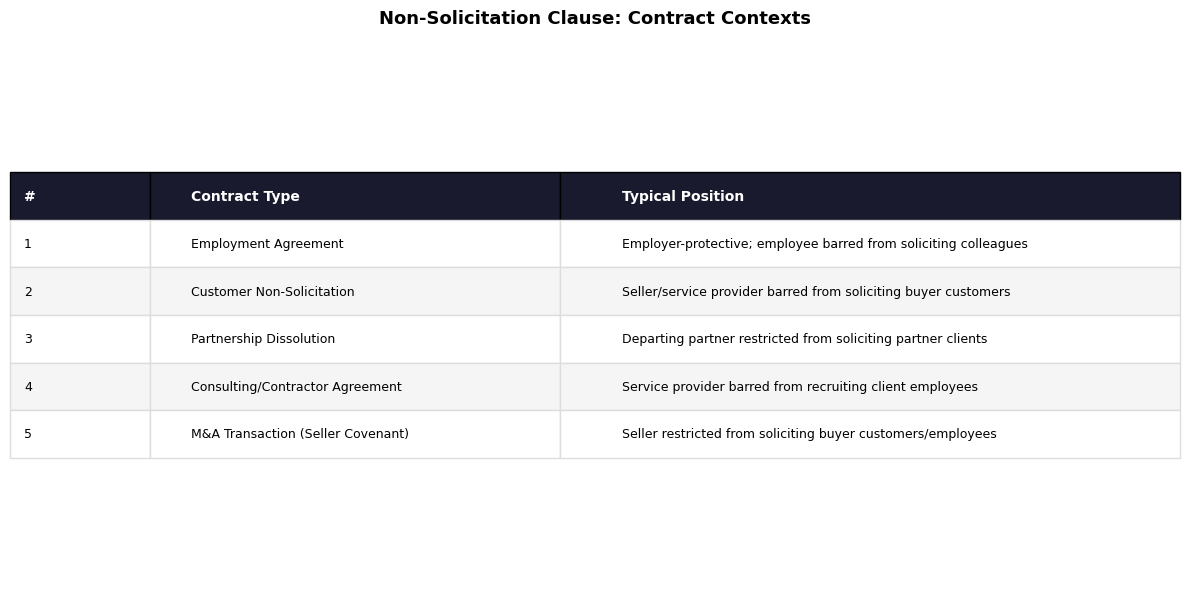
Contract types where Non-Solicitation Clause is critical:
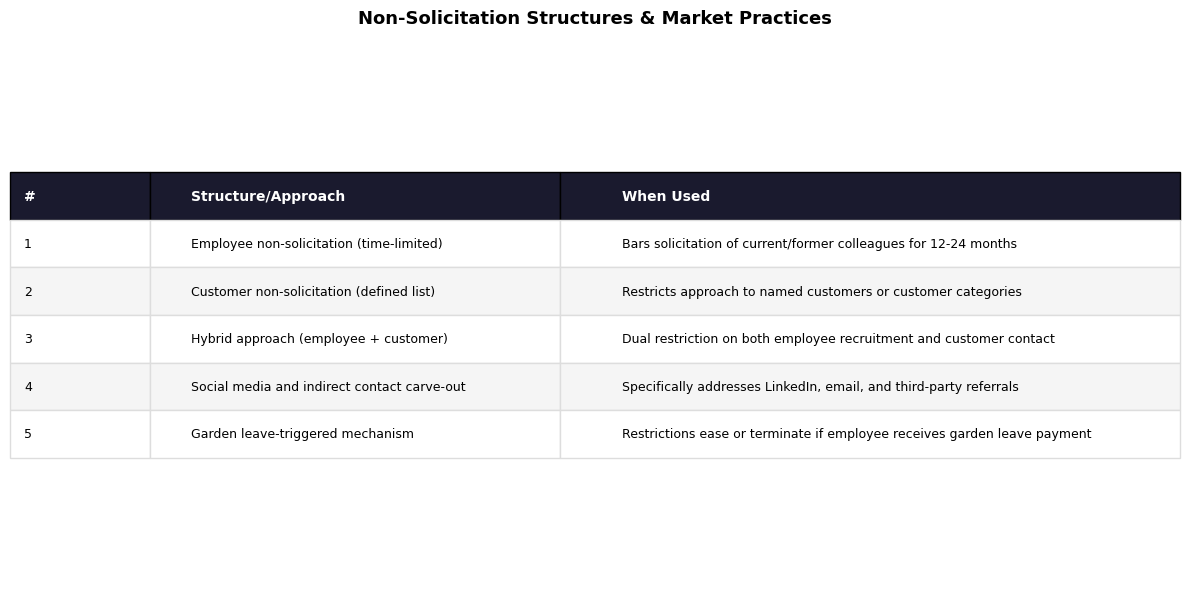
Common structures and market practices:
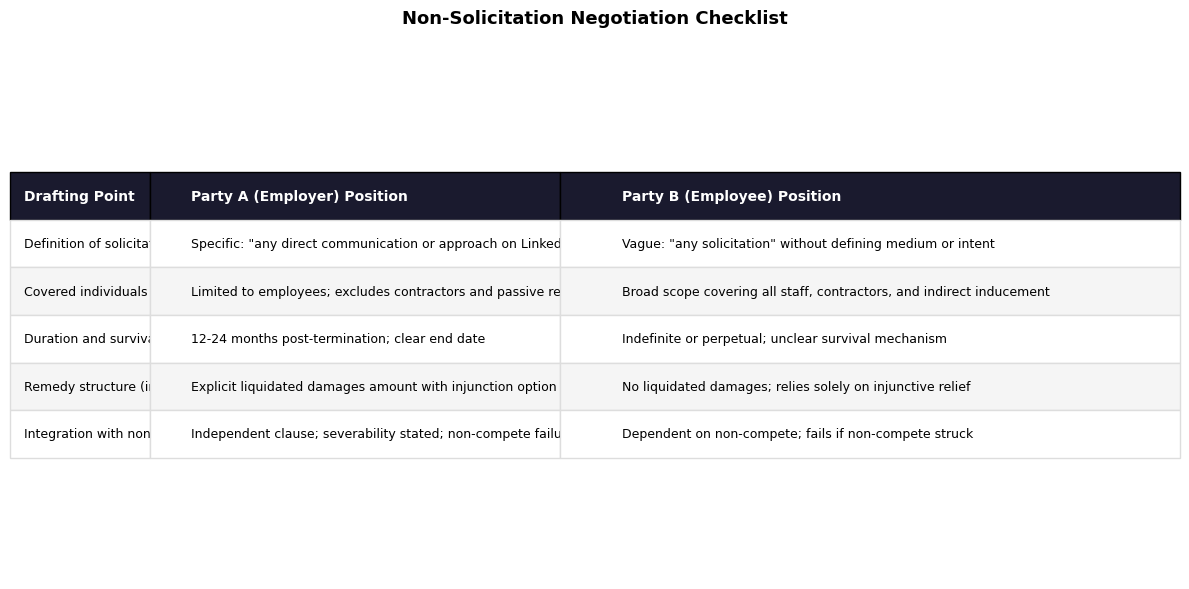
Negotiation Playbook
Key Drafting Notes
- Separate employee and customer non-solicitation into distinct clauses. They serve different purposes, protect different interests, and face different enforceability standards. A court that strikes an overbroad employee non-solicitation should not take the customer non-solicitation down with it. Draft them as independent, severable provisions with their own definitions, durations, and remedy structures.
- Define solicitation to include modern communication channels explicitly. Courts will not infer that "solicitation" covers LinkedIn messages, WhatsApp groups, or third-party introductions unless the clause says so. List every channel: email, phone, text, social media direct message, video conference, and communication through intermediaries. This specificity eliminates the argument that the departing employee's conduct fell outside the clause's scope.
- Attach a Covered Customers exhibit whenever possible. A non-solicitation clause referencing "all customers of the Company" is harder to enforce than one that attaches an exhibit listing specific customer names, account IDs, and revenue thresholds. The exhibit gives the employee clear notice of the restriction's scope and demonstrates to courts that the employer identified specific, protectable relationships rather than claiming blanket protection over an entire market.
- Include a passive-activity carve-out to preempt reasonableness challenges. A clause that prohibits all public-facing activity (job board listings, LinkedIn profile updates, conference attendance) will face judicial skepticism as an effective non-compete disguised as a non-solicitation. Adding explicit language permitting passive activity shows courts that the restriction targets active recruitment, not general professional visibility.
- Pair liquidated damages with injunctive relief. Injunctive relief alone requires proving irreparable harm, which can be difficult if the solicitation has already occurred. Liquidated damages provide a predetermined, enforceable remedy that does not depend on proving actual losses. Set the amount at a level that approximates the employer's real cost of losing the customer or employee (recruitment costs, customer acquisition costs, margin loss) so courts view it as a reasonable estimate rather than a penalty.
Common Pitfalls
- Drafting the non-solicitation so broadly that it functions as a non-compete. If the clause prohibits an employee from "having any contact with" covered customers, it effectively bars the employee from working in the same industry. Courts will reclassify such a provision as a non-compete and apply the stricter enforceability standard. Restrict the clause to solicitation conduct (approaching, encouraging, inducing), not mere contact or association.
- Failing to address the "who approached whom" problem. Without a carve-out for unsolicited inbound contact, an employee who receives an unprompted call from a former customer is technically in breach. Courts view this outcome as unreasonable. Include language stating that the restriction does not apply when the covered customer or employee initiates contact without encouragement from the departing employee.
- Using vague temporal anchors for the covered-persons definition. "Customers of the Company" is indefinite and arguably covers customers from years before the employee joined. Tie the definition to a specific look-back period: "customers with whom Employee had material contact during the 12 months preceding termination." This creates a clear, reasonable universe of covered relationships.
- Ignoring the blue-pencil rules of the enforcement jurisdiction. In states that refuse to reform overbroad restrictive covenants (Virginia, Nebraska, Wisconsin), an overly aggressive non-solicitation is void entirely. Research whether the likely enforcement state permits judicial reformation before drafting. If it does not, err on the side of a narrower clause that survives intact.
- Omitting independent consideration for existing employees. Just as with non-competes, asking a current employee to sign a new non-solicitation without fresh consideration may render it unenforceable. Provide a signing bonus, salary increase, promotion, or additional severance commitment to ensure the clause is supported by bargained-for consideration.
Key drafting notes for a Non-Solicitation Clause:
- Post-FTC Non-Compete Ban Strategy: With non-competes increasingly unenforceable, non-solicitation has become employers' primary employee restraint tool. Draft non-solicitation clauses with the assumption that non-competes will fail. Ensure non-solicitation survives independently: "This clause is severable and shall remain in force even if any non-compete clause is found unenforceable." Make non-solicitation the centerpiece of your restrictive covenant package, not an afterthought.
- Remote Work and Social Media Realities: Define solicitation to explicitly address LinkedIn, email, text, and social media. Courts now expect employers to account for these channels. Vague language like "direct solicitation" fails because it does not signal to employees that a LinkedIn message is prohibited. Include: "Solicitation includes LinkedIn outreach, email, text, phone, or any social media platform." This clarity improves enforceability and gives employees fair notice.
- Carve-Outs for Passive Activity and Unsolicited Inquiries: Include explicit carve-outs for passive job-board presence and unsolicited customer inquiries. Overreaching clauses that bar responding to unsolicited inquiries are more easily struck. A clause that permits "passive response to unsolicited inquiries" is more defensible and preserves employee autonomy while protecting the employer's core interest: preventing active recruitment campaigns.
- Integration with Non-Compete and NDA: Ensure the non-solicitation clause stands independently. Draft explicit language: "This Non-Solicitation is independent of any Non-Compete Clause or NDA. If either the Non-Compete or NDA is found unenforceable, this Non-Solicitation shall continue in full force and effect." This severability language protects the non-solicitation even if the non-compete (vulnerable to 2024 FTC rule challenges) fails.
- Liquidated Damages and Remedies: Specify liquidated damages tied to a reasonable proxy for harm: customer profit margin, recruitment costs, or percentage of customer ARR. Courts enforce liquidated damages clauses more readily than purely injunctive relief, which requires proof of irreparable harm. Example: "Liquidated damages shall be calculated as 50% of the annual revenue attributable to each customer solicited, reflecting the Company's lost margin and customer acquisition cost." This provision strengthens enforceability and deters breach.
Historic note:
Non-solicitation clauses, while older in principle (rooted in common law restrictions on enticement), became formalized in modern commercial contracts only in the mid-20th century, as corporations grew larger and talent became more mobile. Early versions focused on customer non-solicitation in sales-heavy industries (insurance, pharmaceuticals). Employee non-solicitation emerged later, gaining prominence in the tech boom of the 1990s-2000s as competition for skilled engineers intensified. The post-2008 financial crisis and rise of venture capital funding accelerated non-solicitation adoption; VCs demanded non-solicitation provisions in employment agreements as protection against co-founder defections and team poaching. By 2020, non-solicitation had become standard in virtually all private-company and public-company employment agreements, particularly in knowledge-intensive industries. The 2024 FTC non-compete ban has reset the environment; non-solicitation is now the primary restrictive covenant, not a secondary mechanism.
Jurisdiction specific notes:
- U.S. Jurisdictions: Non-solicitation is generally more enforceable than non-compete across all jurisdictions. California, despite its near-total non-compete ban, has enforced narrowly tailored employee and customer non-solicitation clauses (Kerr's Catering, Premier Industries cases). Texas, Delaware, and Florida enforce aggressive non-solicitation language. New York courts enforce non-solicitation if reasonably scoped and tied to legitimate business interests. Even plaintiff-friendly jurisdictions like Illinois and New Mexico enforce customer non-solicitation. The key variable is scope definition: narrow, customer-specific restrictions survive; broad "any person known to the company" language fails. Federal courts, particularly in the Ninth Circuit (West Coast), are sympathetic to narrowly tailored non-solicitation, viewing it as less offensive than non-compete.
- U.K. and International: English law applies the same reasonableness test to non-solicitation as to non-compete, but courts view non-solicitation as less restrictive on livelihood. Customer non-solicitation is readily enforceable if the customer list is clearly defined and the restriction is tied to confidential customer information. Employee non-solicitation is enforced if limited in time and scope (e.g., key employees or direct reports, not all staff). The UK courts are more receptive to non-solicitation than to non-compete, reflecting the doctrine's narrower scope. Canadian law (Ontario, British Columbia) similarly enforces narrowly tailored non-solicitation, particularly customer non-solicitation.
Drafting Tip:
For global teams, use jurisdiction-specific non-solicitation templates. California non-solicitation should be narrow (customer-only, no employee restriction). Texas non-solicitation can be broad (employee + customer, 24-month term). UK non-solicitation should focus on customer lists and key relationships. This tailored approach maximizes enforceability across jurisdictions while avoiding a single clause struck in one jurisdiction from collapsing protections everywhere.
Bottomline:
Non-solicitation clauses have become the primary employee and customer restraint tool in post-2024 practice, replacing non-competes as the core of restrictive covenant regimes. Enforceability is strong across jurisdictions when the clause is narrowly tailored, clearly defining solicitation and covered individuals or customers. Draft with explicit attention to social media and indirect solicitation channels; vague language that omits LinkedIn or email invites litigation. Include reasonable carve-outs for passive activity and unsolicited inquiries to avoid overreach. Specify liquidated damages tied to reasonable harm proxies (customer margin, recruitment cost) to improve enforceability. Segment non-solicitation by customer and employee categories, using tiered approaches for different business units or geographies. Ensure independent severability language so the non-solicitation survives if the non-compete is struck. For strategic protection in competitive markets, pair narrow employee non-solicitation (6-12 months, direct reports only) with broader customer non-solicitation (18-24 months, defined customer list). Monitor state-level legislative activity; several states are considering non-solicitation regulation as part of post-FTC-ban regulatory updates. Use non-solicitation as your primary restrictive covenant; treat non-compete as secondary protection in low-risk jurisdictions (Texas, Florida, Delaware) only.
.avif)