TL;DR:The survival clause determines which obligations outlive the contract and for how long. In 2025-26, with IP disputes stretching years post-termination and GDPR creating indefinite data liability, survival clauses are critical to protecting both sides. For IP and confidentiality, push for indefinite (or at minimum 5+ year) survival - these obligations have value beyond the contract term, and claims often surface late. For reps/warranties and payment obligations in M&A, 12-24 months is market standard, with baskets and caps limiting exposure. Use escrow or holdback provisions to secure indemnity during the survival period - after escrow releases, claims become harder to collect. Avoid the trap of implying survival for clauses that should not survive: if a service provider should have no obligation after termination, say so explicitly ("All payment obligations shall terminate upon Termination Date"). Distinguish between termination (early exit, usually for breach or convenience) and expiration (natural end of term) - both should trigger the same survival, unless drafting intentionally differentiates. For regulatory obligations (GDPR, export controls, data deletion), survival may be mandated by law regardless of what the contract says - flag this in a separate subsection to avoid conflicts. Finally, coordinate survival with limitation periods under governing law - a 12-month contract survival can be rendered pointless if the statute of limitations is 6 years and the counterparty waits 5 years to sue.
What is a Surival Clause?
The survival clause sits at the boundary between contract duration and long-tail obligations. Most contracts contemplate two phases: (1) the term, during which parties perform and earn/pay, and (2) the post-termination period, during which certain obligations linger. The question is which ones. Some obligations naturally outlast the contract - confidentiality, IP ownership, indemnity for past breaches. Others should end immediately - performance obligations, payment for future services, compliance with ongoing covenants. Drafting surviva incorrectly flips these outcomes: you end up paying for services after termination because payment clauses "survive," or you lose indemnity rights against IP infringement claims that surface years later because indemnity was not listed as surviving.
In 2025-26, two risk areas have sharpened. First, post-termination IP disputes in tech: a vendor terminates the agreement, then sues the client claiming the software infringes; does the indemnity clause survive to protect the client? Second, data deletion under GDPR: a service provider deletes data post-termination, but later the client is sued by a data subject; does the data processor's indemnity for data breaches survive to cover the client's exposure? These scenarios require explicit, forward-looking survival language. The interaction between survival and limitation periods (statute of limitations) also matters: if your contract says indemnity survives 12 months post-termination, but the statute of limitations for contract claims is 4 years, the indemnity effectively expires at 12 months even though legal claims could arise later.
Termination vs. expiration creates additional friction. Expiration is natural - contract reaches its end date and stops. Termination is early - a party invokes termination rights due to breach, convenience, or change of circumstances. Should survival clauses treat them identically? Some contracts say "upon termination OR expiration, the following provisions survive..." (treating them the same). Others say "upon termination for cause" or "upon early termination," creating different survival periods depending on the reason. This affects remedies: if Party A terminates wrongfully, should its survival of indemnity obligations be shorter than if the contract simply expired? Modern drafting tends toward uniform survival regardless of termination reason, to avoid disputes about whether a termination was "for cause" or "without cause."
• Express survival clauses name specific provisions that continue post-termination; anything not named typically expires
• Implied survival applies to obligations that logically must continue (indemnity, confidentiality, IP ownership)
• Survival duration interacts with statute of limitations - a 12-month survival clause can expire before legal claims ripen
• Termination (early exit) and expiration (natural end) should have same survival rules unless drafting explicitly differentiates
• Acceptance and payment post-termination create traps: does warranty survive acceptance? Does payment obligation survive if invoice is untimely?
Express Survival vs. Implied Survival: What Continues by Default
- Express Survival: Contract explicitly states which provisions survive. Example: "Upon termination or expiration, the following provisions survive: [list]. All other provisions terminate on the effective date of termination." This is clearest. Parties know exactly what continues and what ends. If a clause is not listed, it does not survive. Creates certainty but requires foresight - you must anticipate which provisions matter post-term.
- Implied Survival: Certain clauses survive by operation of law / contract interpretation, even without express language. These include: (a) confidentiality (information disclosed during contract stays confidential post-term), (b) indemnity (indemnity for past breaches continues), (c) limitation of liability (caps on damages for past events), (d) IP ownership (ownership of pre-existing and work-created IP does not terminate), (e) payment for past services (invoices for work performed stay due). Courts assume these survive because they relate to past events, not ongoing performance.
- Survival by Necessity: Some obligations logically must survive to give effect to the contract. If the contract grants a license to use software, the license does not automatically terminate when the contract ends - unless explicitly said. If the contract requires return of confidential information, that obligation does not terminate until performed. Courts in many jurisdictions will infer survival for these "of necessity" clauses to avoid absurd outcomes.
- Mutual vs. Asymmetric Survival: Some contracts treat both parties' surviving obligations the same. Others are asymmetric: "Buyer's obligations survive 12 months; Seller's indemnity survives 3 years." This reflects bargaining: sellers want their indemnity obligations to have a time limit, but want buyer to remain liable for payment longer. Common in M&A: buyer's reps/warranties survive 12-24 months, but seller's indemnity for breaches survives only 12 months, creating pressure for the buyer to discover and claim breaches quickly.
- Survival of Dispute Resolution Clauses: Does the arbitration clause survive termination? If contract says "arbitration clause survives," disputes about post-termination obligations must go to arbitration, not court. If not mentioned, ambiguity arises: Does arbitration automatically survive, or does it expire with the contract? Best practice: explicitly state "arbitration, indemnity, and limitation of liability clauses survive termination indefinitely."
Duration and Interaction with Limitation Periods
- Survival Duration Mechanics: Contracts specify survival periods: "Representations survive 12 months from closing"; "Indemnity survives 18 months"; "Confidentiality survives 5 years." These run from the termination or closing date. A 12-month survival period means claims must be brought within 12 months; after day 366, claims are barred by the contract itself, regardless of statute of limitations. This is useful for the party seeking finality (seller) but risky for the claimant (buyer) who may not discover breaches within 12 months.
- Interaction with Statute of Limitations: Contract survival periods often conflict with statutory limitations. A statute of limitations for breach of contract is typically 4 years (UCC) or 6 years (common law). If the contract says indemnity survives 12 months, and the statute of limitations is 4 years, what applies? Answer: the shorter period (12 months) controls - the contract has contractually shortened the statutory period. This is valid and enforceable. However, some contracts say "survival period shall not be less than the applicable statute of limitations," creating a floor: the longer of survival period or statute applies. This prevents accidental shortening.
- Basket, Cap, and Survival Stacking: M&A purchase agreements combine survival with baskets and caps. Example: "Buyer may bring indemnity claims within 12 months of closing for breaches of Reps & Warranties, provided individual claims exceed $25K (basket) and aggregate claims exceed $250K (cap), and total recovery cannot exceed $2M (cap). After 12 months, no indemnity claims are permitted." This combines time limit, monetary thresholds, and damage caps - all limiting seller's exposure. The buyer must thread the needle: discover the breach, quantify damages, and bring a claim within 12 months and within the basket/cap structure.
- Escrow as Survival Mechanism: M&A deals often hold back purchase price in escrow to secure sellers' indemnity obligations. The escrow account survives (money is held) for the survival period (e.g., 12 months). On day 366, the escrow releases to the seller, unless a claim was pending (started before day 365). This creates practical finality: after the escrow releases, even pending claims may be limited if the escrow is insufficient. Escrow terms and survival terms must align, or claims go unpaid.
- Knowledge Qualifiers and Discovery Cutoff: Some contracts say "indemnity claims must be brought within 12 months, except claims based on facts known or discoverable within 30 days of closing shall be brought within 12 months of discovery." This extends the period for claims the buyer did not know about, but creates a discovery cutoff - facts you should have discovered within 30 days cannot extend the period later. This is common to balance certainty and fairness.
A well-drafted Survival Clause contains:
- Express List of Surviving Provisions: Name each provision that survives with precision. Do not just say "confidentiality survives indefinitely" - specify which confidentiality clause (e.g., "Article 8: Confidential Information") and what that means (e.g., "all obligations of confidentiality in Article 8 shall continue indefinitely after termination"). Example: "The following provisions shall survive any termination or expiration of this Agreement: (a) Article 3 (Representations and Warranties), for [12/24] months from termination; (b) Article 5 (Indemnification), for [18/36] months from termination; (c) Article 6 (Confidentiality), indefinitely; (d) Article 7 (Limitation of Liability) and Article 8 (Dispute Resolution), indefinitely."
- Survival Duration (Time-Specific): State exactly how long each survives. Example: "Reps survive 12 months from the Closing Date" (not "12 months from termination" which is ambiguous if the contract term is 5 years). For indefinite survival, say so explicitly: "Confidentiality shall survive indefinitely." Indefinite creates practical enforcement issues (courts disfavor indefinite obligations), so consider alternatives: "Confidentiality shall survive for 10 years, except trade secrets shall remain confidential indefinitely."
- Measurement Point (Closing Date, Termination Date, etc.): Specify when the survival period begins and ends. Example: "All representations survive until 12 months after the Closing Date, and any claim must be brought on or before such date." Some contracts say "18 months from the date of termination, or 60 days after discovery of the breach, whichever is later," creating a moving target. For certainty, pick a fixed date (Closing, Effective Date of Termination) and stick with it.
- Survival of Baskets and Caps: If provisions have baskets (minimum to claim) or caps (maximum recovery), specify whether those apply to surviving claims. Example: "Indemnity claims shall be subject to the basket and cap in Article 5 even if brought during the survival period. However, any claim brought within 12 months shall be timely; claims brought after 12 months are time-barred regardless of basket/cap." This prevents the trap where a claim is too small when brought (within basket) but later exceeds the cap if combined with other claims (after the survival period ends).
- Survival of Dispute Resolution and Limitation Clauses: Explicitly state that arbitration and limitation-of-liability clauses survive. Example: "The Arbitration Clause (Article 11) and the Limitation of Liability (Article 12) shall survive any termination or expiration indefinitely and shall apply to all claims, including post-termination claims." Without this, courts may find that when the contract terminates, so do the procedural rules (arbitration instead of litigation), creating uncertainty.
- No Waiver of Survival by Partial Acceptance: Add language preventing parties from waiving survival by accepting or using services post-termination. Example: "Buyer's acceptance of deliverables or services post-Closing shall not waive any representation, warranty, or indemnity obligation. Seller's indemnity obligations survive in full even if Buyer continued using the goods post-termination." This prevents sellers from arguing "you kept using my software, so you waived reps/warranties."
- Interaction with Statute of Limitations (Floor or Ceiling): Clarify whether survival period is a floor (cannot be shorter than statute) or a ceiling (cannot be longer). Example: "The survival periods in this clause shall not operate as a waiver of claims that could otherwise be brought under applicable law. Each party's rights under applicable statutes of limitations shall not be limited by this clause." Alternatively, for certainty: "All claims under this Article must be brought within the survival period or the applicable statute of limitations, whichever is longer." This is seller-protective; buyer would reverse it (whichever is shorter).
Market Position & Benchmarks
Where Does Your Clause Fall?
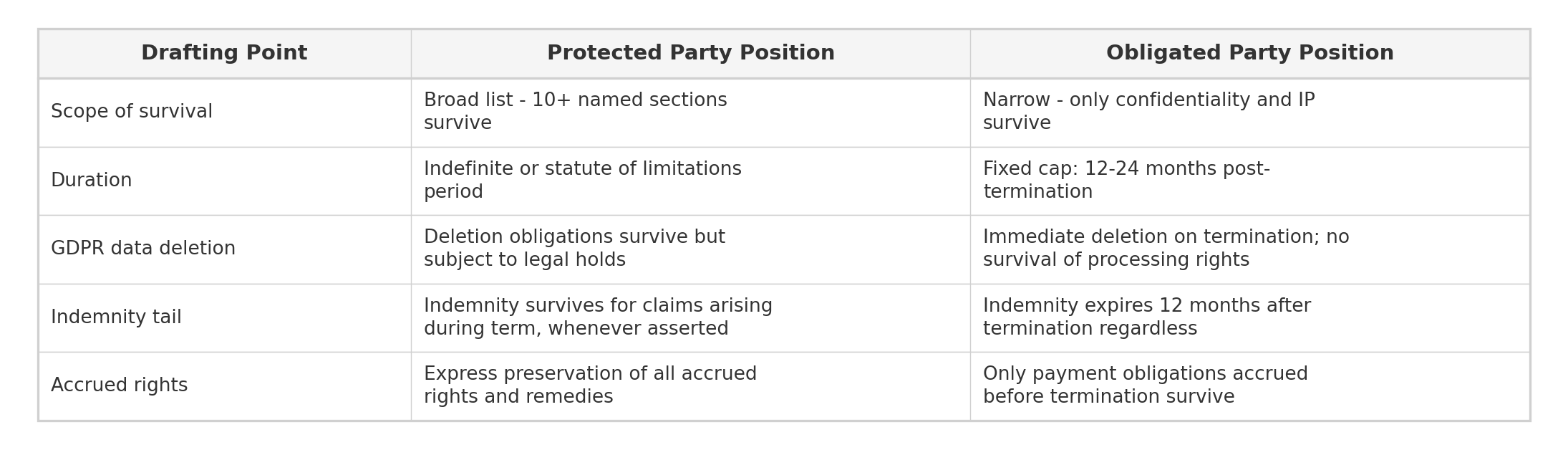
- Seller/Provider-Protective (Short Survival): Representations and warranties survive 12 months from closing or termination. Indemnity obligations survive 12 months, with all claims time-barred thereafter. Confidentiality survives 2-3 years. Survival periods operate as a ceiling; no claims permitted after expiry regardless of statute of limitations. Escrow releases automatically at the end of the survival period unless a formal claim is pending. No discovery-based extensions. Aggregate indemnity cap applies during and after survival. This position prioritizes finality and limits the seller's long-tail exposure.
- Balanced/Market Standard: Representations and warranties survive 18-24 months. General indemnity survives 18-24 months; IP and environmental indemnity survive 3-5 years or indefinitely. Confidentiality survives 5 years, with trade secrets surviving indefinitely. Dispute resolution and limitation of liability survive indefinitely. Survival periods operate as the longer of the stated period or the applicable statute of limitations. Escrow held for 12-18 months with a tail for pending claims. Discovery-based extension for claims not reasonably discoverable within the standard period.
- Buyer/Client-Protective (Long Survival): Representations and warranties survive 24-36 months. IP indemnity and environmental indemnity survive indefinitely. Confidentiality survives 7-10 years or indefinitely for trade secrets. All indemnity obligations survive the longer of the stated period or the applicable statute of limitations. Escrow held for 24+ months. Knowledge qualifiers extend survival for late-discovered breaches. Baskets and caps do not apply to fraud, IP infringement, or environmental claims. No waiver of survival by acceptance of deliverables or continued use post-termination.
Market Data
- In M&A transactions, the median survival period for general representations and warranties is 18 months from closing. Fundamental representations (capitalization, authority, title) survive 36 months or indefinitely in approximately 70% of deals (ABA Private Target Deal Points Study, 2024).
- IP indemnity survives indefinitely in 62% of technology licensing and SaaS agreements. In the remaining 38%, the median survival period is 3 years post-termination (WorldCC Benchmarking Data, 2024).
- Confidentiality survival periods range widely: 2-3 years in standard commercial contracts, 5-7 years in technology and pharmaceutical deals, and indefinite for trade secrets in 80%+ of contracts that address the distinction.
- Escrow holdback amounts in mid-market M&A (deal value $25M-$500M) average 7-10% of purchase price, held for 12-18 months. Approximately 55% of deals include a "tail" provision allowing pending claims to survive escrow release.
- Approximately 45% of negotiated commercial contracts include a "longer of survival period or statute of limitations" floor, preventing the contract from shortening the statutory claim window. This is more common in buyer-protective agreements (65%) than seller-protective ones (20%).
- Dispute resolution clauses (arbitration, governing law, jurisdiction) survive indefinitely in 85% of well-drafted commercial contracts. In contracts where survival is not specified, courts in both the U.S. and U.K. generally infer survival for procedural clauses.
Sample Language by Position
Seller-Protective: "Upon termination or expiration, the following provisions survive for the stated periods: (a) Representations and Warranties (Article 3), 12 months from the Closing Date; (b) Indemnification (Article 5), 12 months from the Closing Date; (c) Confidentiality (Article 7), 2 years; (d) Limitation of Liability (Article 9), indefinitely. All claims under Articles 3 and 5 must be formally asserted (with reasonable specificity as to the breach and estimated damages) on or before the expiry of the survival period; claims not so asserted are forever barred regardless of the applicable statute of limitations. The Escrow Amount shall be released to Seller on the first business day following the 12-month anniversary of Closing, less any amounts subject to pending, timely-asserted claims."
Balanced/Market Standard: "The following provisions survive any termination or expiration of this Agreement: (a) Representations and Warranties (Article 3), for 18 months from the Closing Date (or, for Fundamental Representations, 36 months); (b) Indemnification (Article 5), for 24 months from the Closing Date, except that IP Indemnity (Section 5.3) survives indefinitely; (c) Confidentiality (Article 7), for 5 years, except that trade secrets survive indefinitely; (d) Limitation of Liability (Article 9) and Dispute Resolution (Article 11), indefinitely. Claims must be asserted within the applicable survival period or the statute of limitations under the Governing Law, whichever provides longer protection to the Claiming Party. The Escrow Amount shall be held for 18 months; any balance not subject to pending claims shall be released to Seller thereafter."
Buyer-Protective: "Upon termination or expiration for any reason, the following provisions survive: (a) Representations and Warranties (Article 3), for 24 months (Fundamental Representations survive indefinitely); (b) Indemnification (Article 5), for 36 months for general indemnities, indefinitely for IP infringement and environmental claims; (c) Confidentiality (Article 7), for 7 years, with trade secrets surviving indefinitely; (d) Limitation of Liability (Article 9), Dispute Resolution (Article 11), and Data Protection (Article 14), indefinitely. Survival periods shall not operate to shorten any applicable statute of limitations. Claims based on facts not reasonably discoverable during the standard survival period may be brought within 12 months of discovery. Acceptance of deliverables or continued use of products post-termination does not waive any surviving obligation. Indemnity caps shall not apply to claims arising from fraud, willful misconduct, IP infringement, or environmental contamination."
Example language:
Two versions with different survivor protection:
- Seller-Protective (Short Survival): "Upon termination or expiration of this Agreement, the following provisions shall survive for the periods stated: (a) Representations and Warranties (Article 2) - 12 months; (b) Indemnification (Article 5) - 12 months; (c) Confidentiality (Article 6) - 3 years; (d) Limitation of Liability (Article 9) - indefinitely. All claims must be brought within the survival period stated above or shall be forever barred. The survival periods in this clause shall be the exclusive remedy period and shall not be extended by any statute of limitations or other law."
Example: "The following provisions shall survive any termination or expiration of this Agreement: (1) Representations and Warranties (Article 2) - for 18 months following the Closing Date, (2) Indemnification (Article 5) - for 24 months following the Closing Date, except that claims arising from breach of Representations may be brought within 18 months even if discovered later, (3) Confidentiality (Article 6) - indefinitely, (4) Limitation of Liability (Article 9) - indefinitely and shall apply to all post-Closing claims, (5) Dispute Resolution (Article 11) - indefinitely. All claims must be brought by the applicable deadline or shall be barred. Nothing in this Clause shall be deemed to waive any claim arising from fraud or environmental contamination."
- Buyer-Protective (Long Survival): "Upon termination or expiration, Seller's representations and indemnity obligations survive indefinitely for: (a) IP Infringement (Article 2.5) - indefinite, (b) Environmental/Compliance (Article 2.8) - indefinite, (c) General Representations (Article 2.1-2.4) - 24 months from Closing, (d) Confidentiality (Article 6) - 7 years, (e) Limitation of Liability (Article 9) - indefinitely. Any claim brought within the applicable survival period shall be timely even if the applicable statute of limitations has not yet run, provided Buyer brings suit within 3 years of discovery. Seller's indemnity cap shall not apply to Environmental or IP claims."
Example: "Upon expiration of the Term or termination for any reason, the Parties' obligations under the following provisions shall continue: (a) Confidentiality - 5 years, (b) Indemnification - indefinitely for IP claims, 3 years for other indemnities, (c) Limitation of Liability and Caps on Damages - indefinitely, (d) Dispute Resolution and Governing Law - indefinitely, (e) Return of Materials and Data Deletion - until completed (no time limit). Any provision not listed above shall terminate on the Effective Date of Termination or Expiration. Claims must be brought within the applicable survival period or by the statute of limitations, whichever provides longer protection to the Claiming Party."
Contract types where Survival Clause is critical:
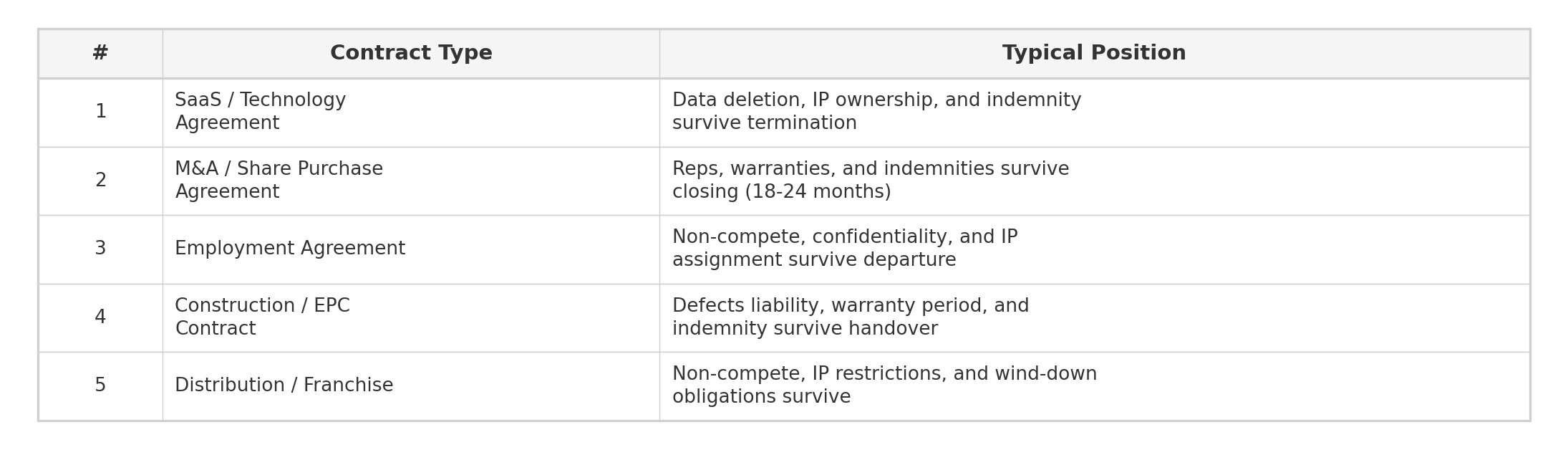
Common structures and market practices:

Negotiation Playbook
Key Drafting Notes
- Always Use Express Survival With Specific Durations: Relying on implied survival is a gamble. Courts will infer survival for some obligations (confidentiality, indemnity for past breaches) but not all, and the inferences vary by jurisdiction. The safest approach is to list every provision that should survive, with a specific duration for each. End the clause with a catch-all: "All provisions not listed above shall terminate on the effective date of termination or expiration." This eliminates ambiguity and prevents disputes about whether an unlisted provision was "intended" to survive.
- Match Survival Periods to the Risk Profile of Each Obligation: Not all obligations deserve the same survival duration. Representations and warranties in a standard commercial contract: 12-18 months (enough time to discover most breaches). IP indemnity: indefinite or 5+ years (patent infringement suits routinely surface 3-7 years after the triggering event). Confidentiality: 5-10 years for business information; indefinite for trade secrets. Payment obligations: should survive only for accrued, unpaid amounts, not future invoices. Tailoring the duration to each obligation's risk profile avoids over-protecting low-risk items while under-protecting high-risk ones.
- Coordinate Survival With Escrow and Holdback Mechanics: In M&A, the survival period and escrow release date must align. If indemnity survives 18 months but the escrow releases at 12 months, months 13-18 of survival are effectively unenforceable (the money is gone). Best practice: set the escrow release date at or after the survival period expiry, with a tail provision holding back amounts for pending claims. If the deal includes both a general escrow and a special escrow (for environmental or tax claims), align each escrow's release date with the corresponding survival period.
- Address the Termination-vs.-Expiration Distinction Explicitly: Use "upon termination or expiration" to trigger survival uniformly. If you draft survival to trigger only "upon termination," a contract that naturally expires may not trigger the survival clause at all, leaving both parties without post-expiration protection. This is a surprisingly common drafting error. Always include both triggers unless you have a deliberate reason to differentiate (e.g., survival of certain obligations only upon termination for cause).
- Include a Statute of Limitations Floor for Buyer Protection: Buyers should insist on language stating that survival periods do not shorten the applicable statute of limitations. Without this, a 12-month survival period contractually bars claims that would otherwise be timely under a 4- or 6-year statute. The formula: "Claims may be brought within the survival period stated above or the applicable statute of limitations, whichever is longer." Sellers will resist this (it defeats the purpose of a short survival period), so expect negotiation. The compromise: apply the floor to fundamental representations and IP claims only, while keeping the ceiling for general reps.
Common Pitfalls
- Omitting Dispute Resolution From the Survival List: If the arbitration or governing law clause does not expressly survive, a party may argue that post-termination disputes should be litigated in court rather than arbitrated, or that a different governing law applies. While most courts infer survival of dispute resolution clauses, the inference is not universal. Always include arbitration, governing law, and jurisdiction clauses in the express survival list, with indefinite duration. The cost of including them is zero; the cost of omitting them is a jurisdictional fight.
- Survival Without Corresponding Limitation of Liability: If indemnity survives for 24 months but the limitation of liability clause does not expressly survive, does the indemnity cap apply to post-termination claims? Ambiguity here can lead to uncapped exposure. Always pair survival of indemnity with survival of the limitation of liability clause for the same period or longer. State: "The limitations of liability in Article X shall apply to all claims, including those arising during the survival period."
- Failing to Distinguish Trade Secrets From General Confidential Information: A blanket "confidentiality survives 3 years" provision may be adequate for general business information but inadequate for trade secrets, which can retain commercial value for decades. Best practice: "Confidential Information (other than Trade Secrets) shall remain confidential for 5 years following termination. Trade Secrets shall remain confidential for so long as they qualify as trade secrets under applicable law." This aligns the contractual obligation with the legal protection available under the Uniform Trade Secrets Act or equivalent legislation.
- Ignoring Data Protection Survival Requirements: GDPR and similar data protection laws create obligations that survive contract termination by operation of law, regardless of what the contract says. A data processor's obligation to delete personal data, respond to data subject requests, and cooperate with regulatory investigations does not end when the processing agreement terminates. If the survival clause is silent on data protection, the contractual indemnity for data breaches may expire even though the legal exposure continues. Include explicit survival for data protection obligations, tied to the applicable data retention and regulatory investigation periods (often 6+ years).
- Using "Survive Indefinitely" Without Considering Enforceability: While "indefinitely" is common for confidentiality and IP obligations, some courts view indefinite contractual obligations with skepticism, particularly for non-compete and restrictive covenant provisions. In jurisdictions that disfavor perpetual obligations, an "indefinite" survival may be reduced to a "reasonable" period by the court. For provisions where you genuinely need indefinite survival (IP ownership, trade secrets), draft explicitly: "This obligation shall survive without time limit and shall not be subject to any judicial reduction for reasonableness." For other provisions, specify a long but defined period (e.g., 10 years) as a fallback.
Key drafting notes for a Survival Clause:
- IP Indemnity Must Survive Long Enough to Cover Claims: Patent infringement claims can surface years after termination - a competitor reverse-engineers your product and claims your vendor's software infringes their patent. If IP indemnity expires 12 months after termination, you are exposed. Market practice in tech: IP indemnity survives indefinitely, or at minimum 3-5 years, to align with the period companies actually receive suit letters. For perpetual licenses, IP indemnity should be perpetual.
- Confidentiality Survival Must Be Longer Than Business Utility: A confidentiality obligation to survive only 2 years after contract termination is weak - trade secrets useful for longer than 2 years. Best practice: confidentiality survives for the longer of (a) 5-10 years, or (b) the period the information qualifies as a trade secret under state law (which is indefinite). This aligns with the Uniform Trade Secrets Act (UTSA) and Economic Espionage Act (EEA).
- Data Deletion and GDPR Interaction: Under GDPR, data processors must delete personal data upon processor's request unless a legal basis (contract) permits retention. Survival clauses that keep data processors liable post-termination can conflict with deletion obligations. Modern SaaS contracts say: "Data processor shall delete personal data within 30 days of termination unless this Agreement permits longer retention for compliance. Data processor's indemnity for data breach claims survives 3 years post-deletion to cover claims arising from pre-deletion processing." This balances GDPR deletion rights with tail indemnity coverage.
- Non-Compete and Non-Solicitation Survival Duration Matters Legally: Non-compete clauses often say "survive termination for [1-3] years." Enforceability depends on jurisdiction and reasonableness. Most states enforce 1-year non-competes; 3-year is borderline; 5+ year is often unenforceable as excessive. In employment agreements, California (and a few other states) prohibit non-competes altogether, so survival language is void. Global deals should note: "To the extent permitted by applicable law, non-compete shall survive for [period]. In jurisdictions where non-compete is prohibited, this obligation shall not apply."
- Acceptance and Survival Mismatch: A buyer accepts delivered goods or software but later discovers defects. Does warranty survive acceptance? Answer depends on what the contract says. If the survival clause says "reps survive 12 months," a buyer's failure to inspect before acceptance does not shorten the 12-month period. But acceptance can waive some warranties under UCC 2-606. To avoid this trap, add: "Acceptance of deliverables shall not waive any representation, warranty, or indemnity. All representations and warranties survive acceptance in full for the periods stated in Article X."
Historic note:
In older contract practice, survival clauses were rarely mentioned - contracts simply ended on their term date and all obligations ceased. This changed with securitization and M&A, which required sellers to warrant accuracy of financial and legal representations post-closing and stand behind them with indemnity. The survival clause became necessary to specify how long sellers remained liable. Early M&A deals had no survival limits, exposing sellers to unlimited tail liability. Over the 1990s-2000s, survival became time-limited (12-24 months) to reduce seller risk and make deals bankable (indemnity tail insurance could be priced if the period was known). The modern survival clause reflects this negotiation: buyers want indefinite survival for IP and environmental; sellers want 12-month cutoffs for reps and warranties. The compromise is asymmetric survival: IP indemnity indefinite, other indemnities 12-18 months, reps 12-24 months, with baskets and caps layered on top.
Jurisdiction specific notes:
- U.S. Common Law and UCC: U.S. law does not impose a default survival period - contracts typically control. Under UCC 2-725, breach of warranty claims must be brought within 4 years of tender of goods, and this period cannot be shortened below 1 year. However, non-UCC services and IP contracts can impose survival periods of any length. Courts enforce survival clauses as written, including short periods (e.g., 6 months) that effectively cut off claims. A few states (e.g., California) impose reasonableness limits on non-compete survival, but not on warranty or indemnity survival. Bankruptcy complicates: if a party files Chapter 11, does the survival clause survive? Answer: yes, assuming it is not a "claim" that can be discharged in bankruptcy. Indemnity obligations in bankruptcy are tricky - a bankrupt entity's indemnity obligation may be discharged, shortening effective survival.
- U.K. Law: English law distinguishes between "warranty" (contractual promise, breach triggers indemnity) and "representation" (pre-contract statement, breach triggers rescission or claim for damages). Survival of warranties is contractual; survival of representations is limited by statute (Misrepresentation Act 1967) and common law. By default, indemnity for breach of warranty survives indefinitely unless limited by contract. GDPR affects data processor liability: survival of data processor's indemnity survives indefinitely for data protection breaches, even if the contract terminates. Limitation periods under English Limitation Act 1980: contract claims, 6 years; tort claims, 3 years. A contract can shorten survival but not below these statutory periods for certain claims.
Drafting Tip - Global Deals:
In cross-border deals, specify survival periods that work across jurisdictions. Example: "Reps survive the longer of (a) [18] months from Closing, (b) any applicable statute of limitations in the Governing Law jurisdiction, or (c) any survival period required by regulation (including GDPR for data-related claims). Indemnity for IP claims survives indefinitely. Confidentiality survives [7] years or for the duration the information qualifies as a trade secret, whichever is longer. To the extent any survival period is unenforceable under applicable law, it shall be modified to the maximum period permitted." This prevents accidental shortening due to jurisdictional differences while preserving enforceability across borders.
.avif)