TL;DR:Warranties are the bridge between what a seller promises and what happens when those promises fail. A weak warranty clause invites disputes: the buyer thinks they're getting a full refund or indemnity, the seller thought they were only offering repair. A strong warranty clause is precise about what's covered, for how long, and what the remedy is. In 2025-26, add explicit carve-outs for AI-generated content, supply chain substitutions, and cybersecurity incidents beyond the seller's control. And always remember: an express warranty you actually state will override an "AS-IS" disclaimer, so be careful what you promise verbally or in product documentation.
What is a Warranty Clause? How are Warranties different from Representations?
Warranties in commercial contracts serve a fundamental risk-allocation function. When you buy software, receive deliverables from a contractor, or procure goods, the warranty clause tells you exactly what promises the seller is making and what happens if they fail to deliver. The distinction between a warranty and a representation matters more than many drafters realize: representations are statements of fact at signing time, while warranties are ongoing promises about the product or service itself.
In 2025-26, warranty provisions have grown more complex as businesses grapple with AI-generated deliverables (how do you warranty something a machine generated?), supply chain disruptions (component substitution affecting product specs), and the shift to SaaS models where uptime and security guarantees replace traditional product warranties. For EV manufacturers and tech companies, Lemon Law expansions mean consumer warranty obligations have become a material legal liability, not a boilerplate afterthought.
A well-drafted warranty clause leaves no ambiguity. It specifies exactly what is warranted, for how long, under what conditions, and what the buyer can actually do (repair, replacement, refund, indemnification) when a warranty fails. It also clearly disclaims what is NOT warranted, protecting the seller from unreasonable claims while respecting the buyer's legitimate expectations.
Key components of warranty risk allocation:
• Express warranties (seller's explicit promises) vs. implied warranties (courts may impose these automatically)
• Disclaimer of implied warranties (AS-IS language) - critical for seller protection, but often unenforceable for consumers
• Warranty period (timeframe for claims) and remedies (repair, replace, refund, or indemnity)
• Indemnification for breach of warranty (seller covers buyer's downstream losses)
• Magnuson-Moss Act compliance (US consumer warranties) and UCC Article 2 (sale of goods)
Express vs. Implied Warranties
- Express warranties are promises you actually make in writing - "this software will process 10,000 transactions per second" or "this painting is an original Monet." If you say it and it turns out false, you're on the hook. Express warranties survive despite disclaimers of implied warranties.
- Implied warranties are legal defaults. Under UCC Article 2, sellers automatically warrant that goods are merchantable (fit for ordinary use) and fit for a particular purpose (if the buyer told you the intended use and relied on your expertise). Courts impose these even if your contract doesn't mention them. That's why "AS-IS" language exists - to reject implied warranties in B2B sales (though consumer protection laws often override this).
- AI-generated deliverables create a new warranty gray area. If a vendor delivers AI-written code or content and warrants it's original or error-free, what exactly are they promising? Many 2025-26 contracts now include explicit carve-outs: "Deliverables incorporating AI training data are provided AS-IS with no warranty of originality."
Warranty Periods, Remedies, and Limitations
- Warranty period sets the window for claims - often 12 months from delivery, sometimes longer for critical systems. For software, it might be "duration of the subscription." The period directly affects liability exposure, so sellers push for short windows while buyers resist.
- Exclusive remedies are critical. The clause should specify: if a warranty fails, the seller will repair it, replace it, or refund the fee. That's it. No liability for lost profits, downtime, or indirect damages. Many disputes arise because the contract doesn't clearly state whether "remedy" means replacement OR refund (seller chooses) or the buyer can pick.
- Consequential damages disclaimers are the safety valve. Even if a warranty fails catastrophically, the seller isn't liable for the buyer's business losses. However, these disclaimers often fail in consumer transactions or when the breach was caused by the seller's gross negligence.
- Supply chain warranty gaps emerged in 2023-24 as component shortages forced substitutions. A seller might warranty a product's performance but note: "If supply constraints require component substitution, warranty coverage extends only to equivalent performance, not specific component sourcing."
A well-drafted Warranty Clause contains:
- Specific commitment: A clear statement of what is warranted - "The Software will perform in accordance with the Documentation" beats vague language like "the Software is fit for use."
- Warranty period: Explicit start and end date or timeframe - "for twelve months from Delivery Date" or "for the Term of this Agreement."
- Conditions and exclusions: What is NOT covered - misuse, unauthorized modifications, third-party integrations, normal wear, or force majeure events.
- Exclusive remedy: What the buyer gets if warranty fails - repair, replacement, or refund at seller's election. This is the valve that protects the seller from indemnity spirals.
- Warranty disclaimer: Clear language disclaiming implied warranties - "EXCEPT AS EXPRESSLY SET FORTH HEREIN, SELLER DISCLAIMS ALL IMPLIED WARRANTIES OF MERCHANTABILITY AND FITNESS FOR A PARTICULAR PURPOSE."
- No indemnification for consequential damages: Seller doesn't cover buyer's lost profits, business interruption, or data loss even if warranty fails.
- Duty to mitigate: Buyer must take reasonable steps to limit harm - don't let a failed warranty cascade into months of avoidable losses and then demand indemnity.
Market Position & Benchmarks
Where Does Your Clause Fall?
- Seller-Favorable: Narrow express warranty limited to conformance with specifications for 30-90 days from delivery, exclusive remedy of repair or replacement at seller's sole election, full disclaimer of all implied warranties, no liability for consequential or indirect damages, and a requirement that buyer report defects within 15 days of discovery. This position minimizes the seller's exposure and is typical of commodity goods and standard software licenses.
- Balanced/Market Standard: Express warranty of conformance with specifications and freedom from material defects for 12 months, exclusive remedy of repair, replacement, or refund at seller's election (with buyer's right to demand a refund if repair fails twice), disclaimer of implied warranties except to the extent prohibited by law, consequential damages cap tied to fees paid, and a 30-day defect notification window. This is the most common position in mid-market enterprise procurement.
- Buyer-Favorable: Broad warranty covering conformance, fitness for purpose, freedom from defects, and compliance with applicable laws for 24 months or the contract term, buyer's choice of remedy (repair, replacement, or full refund), pass-through of manufacturer warranties, no consequential damages disclaimer (or carve-outs for IP infringement and data breach), seller indemnity for third-party claims arising from warranty breach, and representation that deliverables do not infringe third-party IP.
Market Data
- The standard warranty period in enterprise software agreements is 12 months from acceptance, with approximately 30% of deals extending to 24 months for mission-critical systems (Gartner IT Contract Benchmark, 2024).
- Approximately 80% of B2B goods contracts include an express warranty disclaimer of implied warranties (merchantability and fitness); however, only 45% of those disclaimers are drafted with the conspicuous language required under UCC Section 2-316 to be enforceable.
- Exclusive remedy provisions specifying "repair or replace at seller's election" appear in roughly 70% of manufacturing and procurement contracts. Buyer-favorable "repair, replace, or refund at buyer's election" language appears in approximately 15% of negotiated enterprise deals.
- Pass-through warranty clauses (where the seller passes through the original manufacturer's warranty to the buyer) appear in 55% of distribution and reseller agreements, but fewer than half include direct privity between the buyer and the manufacturer.
- AI-specific warranty carve-outs or disclaimers now appear in approximately 40% of technology service agreements involving AI-generated deliverables, up from under 5% in 2022 (ACC Technology Contracting Survey, 2025).
Sample Language by Position
Seller-Favorable: "Seller warrants that the Products will conform to the Specifications for a period of sixty (60) days from the date of delivery. Seller's sole obligation and Buyer's exclusive remedy for breach of this warranty shall be, at Seller's election, repair or replacement of the non-conforming Product. SELLER DISCLAIMS ALL OTHER WARRANTIES, EXPRESS OR IMPLIED, INCLUDING WITHOUT LIMITATION THE IMPLIED WARRANTIES OF MERCHANTABILITY AND FITNESS FOR A PARTICULAR PURPOSE. IN NO EVENT SHALL SELLER BE LIABLE FOR ANY INDIRECT, INCIDENTAL, SPECIAL, OR CONSEQUENTIAL DAMAGES ARISING FROM BREACH OF WARRANTY."
Balanced/Market Standard: "Seller warrants that the Products will conform to the Specifications and will be free from material defects in materials and workmanship for twelve (12) months from the date of acceptance. If a Product fails to meet this warranty, Seller shall, at its election, repair, replace, or refund the purchase price of such Product. If Seller's repair fails to remedy the non-conformity after two (2) attempts, Buyer may elect a full refund. Buyer must notify Seller of any non-conformity within thirty (30) days of discovery. EXCEPT AS EXPRESSLY SET FORTH HEREIN, SELLER DISCLAIMS ALL IMPLIED WARRANTIES OF MERCHANTABILITY AND FITNESS FOR A PARTICULAR PURPOSE TO THE MAXIMUM EXTENT PERMITTED BY APPLICABLE LAW."
Buyer-Favorable: "Seller warrants that all Deliverables will (a) conform to the Specifications and Documentation, (b) be free from defects in design, materials, and workmanship, (c) be fit for Buyer's intended purpose as communicated to Seller, and (d) not infringe any third-party intellectual property rights, for a period of twenty-four (24) months from the date of final acceptance. If any Deliverable fails to meet this warranty, Buyer may, at its sole election, require Seller to repair, replace, or provide a full refund, and Seller shall indemnify Buyer against any third-party claims arising from such breach. Seller shall pass through to Buyer all warranties received from manufacturers and component suppliers."
Example language:
Here are two different warranty formulations - one favoring the seller, one more balanced:
- Seller-favorable: "Seller warrants that the Products will conform to the Specifications for thirty days from Delivery. This is the exclusive remedy for non-conformity. All other warranties, express or implied, are disclaimed."
- Balanced approach: "Seller warrants that the Products will conform to the Specifications for twelve months from Delivery, and will be free from defects in materials and workmanship. If a Product fails to conform, Seller will, at Seller's election, repair, replace, or refund the Fee. Buyer must notify Seller of any non-conformity within thirty days of discovery."
Example 1: Software Warranty (SaaS Model)
"Seller warrants that the Service will maintain 99.5% uptime (measured monthly, excluding Scheduled Maintenance windows) and will perform in material accordance with the Documentation. Seller will remedy Critical Defects within 24 hours and non-Critical Defects within 5 Business Days. This warranty applies only if Buyer (a) uses the Service in accordance with the Documentation, (b) maintains the latest approved version, and (c) does not integrate unauthorized third-party software. Seller does not warrant that the Service will be error-free or meet any particular performance target beyond the 99.5% uptime commitment. THIS WARRANTY IS EXCLUSIVE AND IN LIEU OF ALL OTHER WARRANTIES, EXPRESS OR IMPLIED."
Example 2: Goods Warranty (with Supply Chain Carve-Out)
"Seller warrants that each Product will be free from defects in materials and workmanship and will conform to the Specifications for twelve months from Delivery. If a Product fails to meet this warranty, Seller will repair or replace it at Seller's election, at no cost to Buyer. Notwithstanding the foregoing, Seller reserves the right to substitute equivalent components if supply constraints make the original components unavailable. Seller disclaims all other warranties, including implied warranties of merchantability and fitness for a particular purpose. Buyer's exclusive remedy for warranty breach is repair or replacement. Seller is not liable for Buyer's lost profits, business interruption, or indirect damages even if such damages arise from breach of warranty."
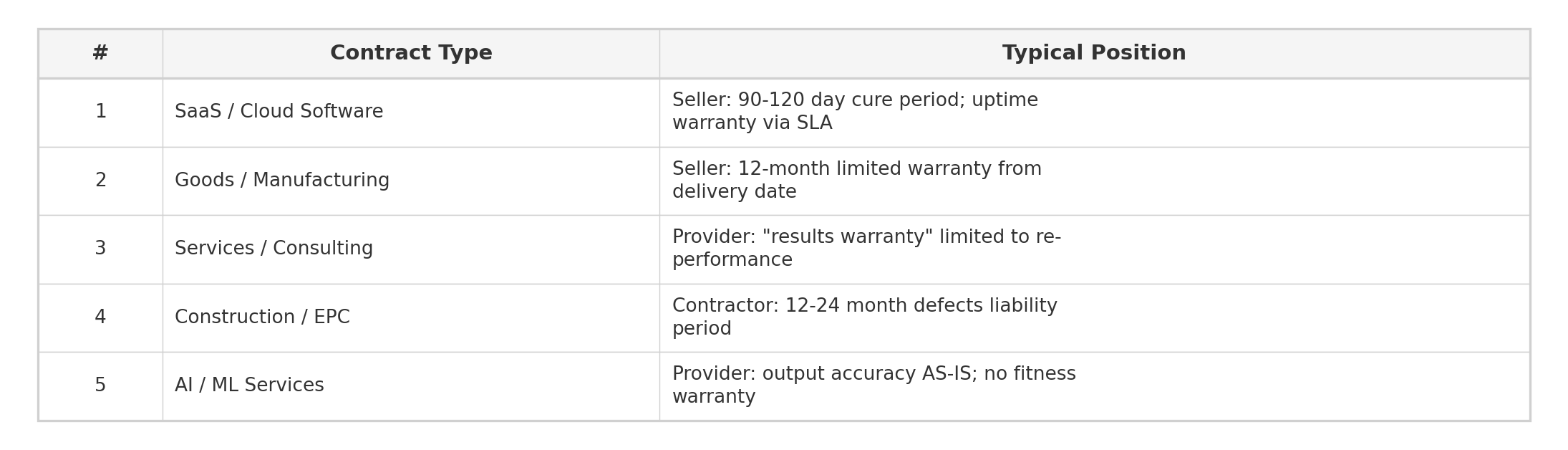
Contract types where Warranty Clause is critical:
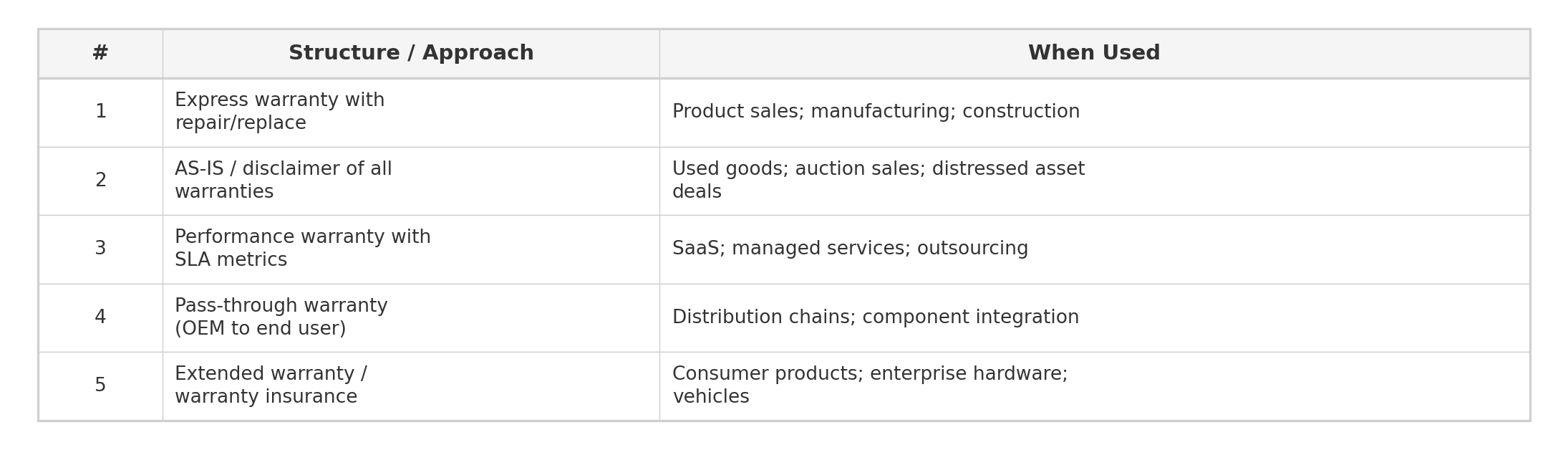
Common structures and market practices:
Negotiation Playbook
Key Drafting Notes
- Anchor the warranty to objective specifications, not subjective standards: "Conforms to the Specifications" is enforceable and testable. "Fit for use" or "performs satisfactorily" invites disputes because both parties will define these terms differently after a failure occurs. Attach the specifications as a schedule and reference them by name in the warranty clause.
- Separate the warranty from the representation: Representations are statements of fact at signing (e.g., "Seller has the right to sell the goods"). Warranties are ongoing performance promises (e.g., "The goods will remain free from defects for 12 months"). Mixing the two in a single clause creates confusion about breach timing, remedies, and survival periods. Draft separate representation and warranty sections.
- Define the remedy waterfall explicitly: Specify the order of remedies and who controls the election. The strongest seller position is "repair, then replace, then refund, at seller's sole election." The strongest buyer position is "repair, replace, or refund at buyer's election." A balanced approach gives the seller two attempts to repair before the buyer can elect a refund. Whatever you choose, spell it out; ambiguity here is the single most common source of warranty disputes.
- Address pass-through warranties in supply chain deals: If the seller is reselling or integrating third-party components, specify whether the seller warrants the entire product (including third-party components) or merely passes through the manufacturer's warranty. If pass-through, confirm that the buyer has direct privity or at least a contractual right to enforce the manufacturer's warranty through the seller.
- Carve out AI-generated deliverables with precision: A blanket "AS-IS" disclaimer for all AI outputs may be too broad and may undermine the buyer's expectations. Instead, specify which deliverables incorporate AI-generated content, what the seller does and does not warrant about those deliverables (e.g., "Seller warrants that AI-generated code will pass automated testing but does not warrant originality or freedom from latent errors"), and what additional review or validation the buyer is expected to perform.
Common Pitfalls
- Relying on "AS-IS" without proper conspicuousness: Under UCC Section 2-316, a disclaimer of implied warranties must be conspicuous (e.g., uppercase, bold, or contrasting font) and must specifically mention "merchantability." A buried, lowercase "as-is" buried in paragraph 47 of a 60-page agreement is unlikely to survive a court challenge. Format matters as much as substance.
- Failing to specify the warranty trigger date: "12 months from delivery" and "12 months from acceptance" can differ by weeks or months if there is a testing or commissioning period. If the warranty period starts on delivery but acceptance testing reveals defects that take months to fix, the buyer may find that most of its warranty period has already elapsed by the time the product is actually working.
- Overlooking the interaction between warranty and indemnity: Many contracts contain both a warranty clause and a separate indemnification clause. If the indemnity covers "any breach of this Agreement" (including warranty breach), it may effectively override the exclusive remedy in the warranty clause. Either align the two clauses or include an express statement that the exclusive remedy in the warranty clause is the sole remedy for warranty-related claims, notwithstanding any broader indemnity.
- Ignoring warranty stacking in multi-vendor deals: When a buyer procures a system from an integrator that includes components from multiple vendors, each vendor may offer different warranty terms, periods, and remedies. Without a master warranty framework, the buyer faces a patchwork of obligations and gaps. Require the integrator to provide a single, unified warranty covering the entire system, with back-to-back terms from component vendors.
- Making verbal promises that create express warranties: Under UCC Section 2-313, any "affirmation of fact or promise" that becomes part of the basis of the bargain creates an express warranty. Sales presentations, demo environments, marketing materials, and even pre-sale emails can create warranty obligations that survive despite a contractual merger clause. Train sales teams to avoid performance claims that exceed what the contract actually warrants.
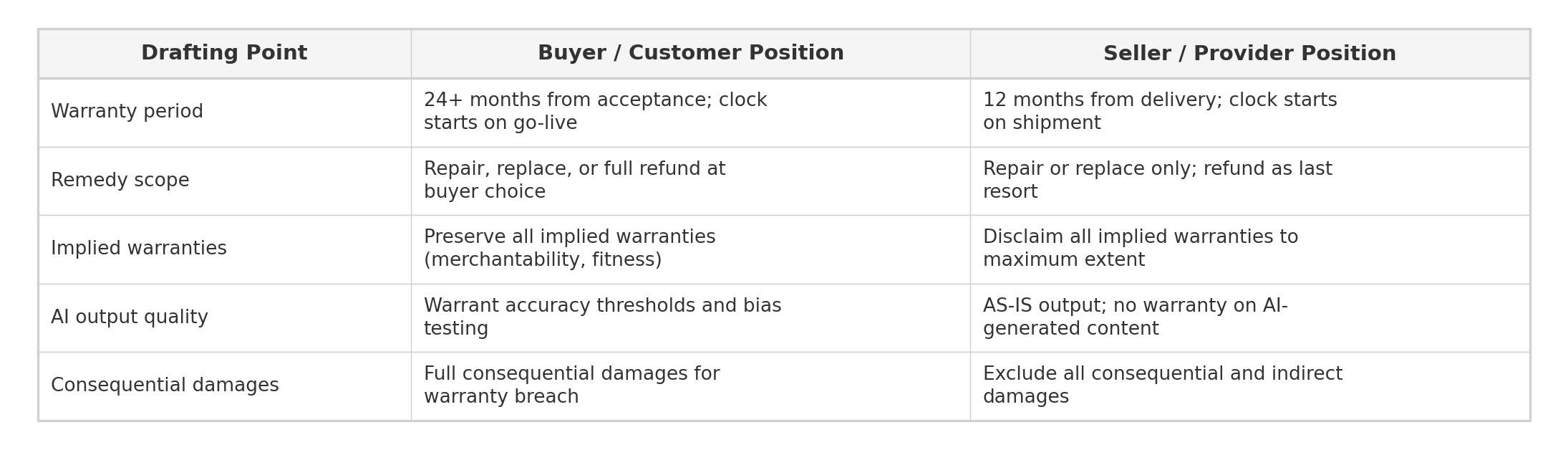
Key drafting notes for a Warranty Clause:
- Distinguish express from implied: Explicitly state what you ARE warranting, then disclaim implied warranties. Courts won't let you hide behind "AS-IS" if you made an express promise that contradicts it.
- Remedy must be exclusive: If the buyer can choose between repair, replacement, or indemnity, pick one. "At Seller's election" protects you; "at Buyer's election" exposes you. Make sure it's clear who decides.
- Set a reasonable warranty period: Six months is aggressive for seller protection; 24 months is common for enterprise software. For goods, 12 months is standard. Longer periods = more liability exposure.
- Address AI and automation: If you're delivering AI-generated content, code, or recommendations, add explicit language: "Deliverables incorporating AI are provided AS-IS. Seller makes no warranty regarding originality, accuracy of AI outputs, or elimination of AI-generated errors."
- Build in the notification window: Require the buyer to report breaches within 30 days of discovery. After that, they've lost the claim. This limits surprise claims from months or years later.
Historic note:
Warranty law in the US traces back to the Uniform Commercial Code (UCC), drafted in the 1950s-60s around the sale of goods. Article 2 created the distinction between express and implied warranties, which has shaped commercial practice ever since. The Magnuson-Moss Act (1975) added a consumer protection layer, requiring merchants to honor warranty disclaimers in writing and preventing them from excluding implied warranties entirely for consumer purchases. In the SaaS era, courts have struggled to apply 70-year-old goods law to software services, leading to uncertainty about whether UCC Article 2 even applies. Most modern contracts sidestep this by defining their own warranty framework entirely, discarding UCC defaults in favor of explicit language.
Jurisdiction specific notes:
- U.S.: UCC Article 2 applies to sale of goods. Implied warranties of merchantability and fitness survive unless disclaimed with conspicuous language using the word "merchantability" (for goods sales). For services and software, UCC Article 2 may not apply, so explicitly define warranty terms or courts will impose a duty of reasonable care. Consumer transactions are governed by state consumer protection laws and the Magnuson-Moss Act, both of which restrict warranty disclaimers.
- U.K.: The Consumer Rights Act 2015 implied statutory rights into all consumer contracts (goods must be of satisfactory quality and fit for purpose). B2B sales are still governed by the Sale of Goods Act 1979, where implied warranties exist but can be disclaimed between sophisticated parties. Be explicit about what is and isn't warranted in B2B deals.
Drafting tip:
In multi-jurisdictional deals, warranty language often needs customization. A warranty clause that flies in California may be unenforceable in Germany (under GDPR data processing) or the UK (under consumer law carve-outs). Run jurisdiction-specific warranty language past local counsel before signing.
.avif)