TL;DR:The assignment clause is a hidden deal-maker or deal-killer. Many negotiators focus on payment terms and liability caps, overlooking that a single "no assignment without consent" buried in a 200-page contract can block a future sale. In 2025-26, when private equity and M&A are active, ask three questions before signing: (1) What does "change of control" trigger assignment consent? (2) Who can grant consent and on what timeline? (3) What if the counterparty is acquired by a competitor - can they withhold consent on conflict grounds? Draft assignment clauses anticipating not just your immediate relationship but your counterparty's likely future acquirer. If you are the assignee-to-be (the buyer), fight for affiliate carve-outs and "consent not unreasonably withheld" with short deemed-consent windows. If you are the original party facing risk, keep language tight: restrict change of control definition, require written notice, and reserve the right to terminate if creditworthiness drops. Sanctions risk adds another layer - conditional assignment language covering sanctions exposure is now table stakes in cross-border deals.
What is an Assignment Clause?
The assignment clause sits at the intersection of contract stability and deal flexibility. When a party wants to exit a deal, merge into a larger entity, or sell its business, assignment rules either open or close the door. The risk is asymmetrical: overly broad restrictions kill transaction value; overly loose terms expose the original counterparty to unknown successors. In cross-border M&A with sanctions implications, assignment also becomes a regulatory gate - you cannot assign a contract to a sanctioned entity even if the other side agrees.
Assignment (the transfer of rights) differs from delegation (passing duties to someone else). You can often delegate performance, but the original party stays liable. However, assignment of rights without assuming duties is cleaner but leaves the counterparty dealing with someone unfamiliar. The real friction arises when assignment is conditioned on consent "not to be unreasonably withheld" - sounds fair, but what constitutes "reasonable"? Is a change of control a trigger even if creditworthiness is unaffected? Can a party withhold consent based on competitive concerns?
The 2025-26 dealscape reveals assignment as a material value driver. Private equity sponsors quietly restructure portfolio companies within fund vehicles, expecting smooth contract portability. Government contracting (FAR clauses) renders contracts non-assignable by doctrine - personal performance and security clearances don't travel. Bankruptcy introduces Section 365 complexity: a debtor can assume or reject contracts, and some assignments are barred (personal services, exclusive licenses). IP licensing chains multiply the friction - a licensor may prohibit sublicensing even though the license itself is "assignable." The lesson: read assignment backwards from your counterparty's likely future moves.
• Assignment transfers contract rights to a third party; delegation passes duties but original party usually remains liable
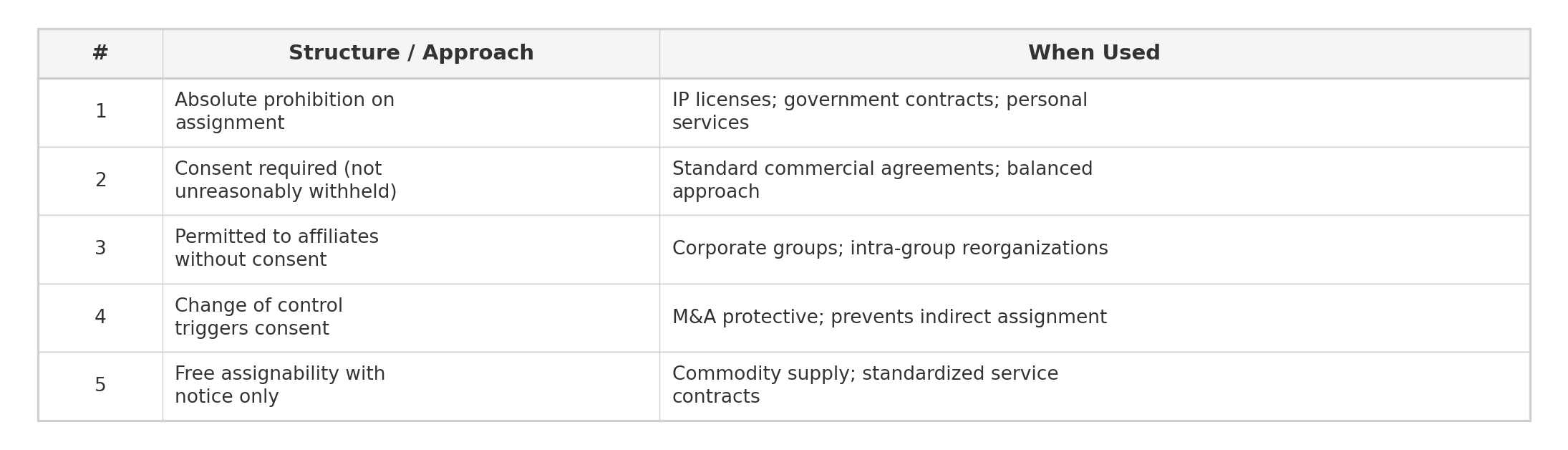
• Consent standards range from absolute prohibition to "not unreasonably withheld" to blanket affiliate carve-outs
• Change of control triggers often function as hidden assignment gates in PE rollups
• FAR, bankruptcy, and sanctions law can veto assignment even with written consent
• Assignment vs. delegation: confusing the two is a common drafting trap
Assignment vs Delegation: The Operating Distinction
- Assignment (Rights Transfer): Party transfers benefits of contract to third party. Original party is relieved of further performance unless agreement states otherwise. If contract is fully assignable, assignee steps into all rights.
- Delegation (Duty Transfer): Party delegates performance obligation to third party, but remains liable if delegate fails. Counterparty must accept delegate performance. Useful when performance is routine (supply delivery, service provision) but risky for discretionary obligations.
- Mixed Assignment & Delegation: Party transfers both rights and duties. Requires counterparty agreement to novation (three-party agreement releasing original party). Most common in M&A: buyer steps into supplier contracts post-closing, but seller may retain indemnity tail for pre-closing events.
- Prohibited Assignment: Contract explicitly bars assignment without consent, or makes assignment material breach. Courts in most U.S. states still allow assignment of ordinary contract rights, but parties can override this with explicit language.
- Affiliate-Only Assignment: Party can assign to subsidiary or parent, typically without consent, but not to third parties. Useful for corporate structures where contracts need portability within a group but control must stay inside the family.
Consent Standards: What "Reasonable" Actually Means
- Consent Not to Be Unreasonably Withheld: Default under UCC 2-210 for sale of goods; party can withhold consent only on rational, business-related grounds (creditworthiness, competitive conflict, performance risk). Burden shifts to withholder to justify denial. Most common in commercial contracts; creates objective test.
- Consent in Sole Discretion (or "Absolute Refusal"): Party can refuse consent for any reason or no reason. Pure control; less common now because courts disfavor unfettered discretion. Raises good-faith and fair-dealing questions depending on jurisdiction.
- Deemed Consent Mechanisms: If consent not given within 30 days, assignment proceeds. Useful for assignor who wants certainty; risky for withholder who must actively monitor. Increasingly seen in PE financing where time-to-close matters.
- Competitive/Conflict Carve-Out: Party can withhold consent if assignee is competitor or creates conflict of interest. Requires careful definition of "competitor" (same market segment? broader industry?). Often creates dispute because assignor argues narrowly while withholder argues broadly.
- Creditworthiness Approval: Counterparty has right to evaluate assignee's creditworthiness. Standard in loan syndication (lender to lender); less common in operational contracts unless counterparty is risk-averse. Requires clear metrics: credit rating, financial ratios, insurance requirements.
A well-drafted Assignment Clause contains:
- Clear Definition of Scope: Does the clause apply to rights only, rights and obligations, or include change of control? Language like "neither party may assign this agreement without consent" is ambiguous - assign what? Consider: "Neither party may assign its rights or delegate its duties without the prior written consent of the other party, except that the Buyer may assign to any affiliate without consent, provided that such affiliate agrees in writing to assume all obligations hereunder."
- Consent Standard and Timing: If consent required, specify whether it is (a) in sole discretion, (b) not to be unreasonably withheld, or (c) deemed granted after 30 days if no response. Include notice period (e.g., "at least 30 days' prior written notice"). Clarity here prevents post-assignment disputes about whether withholder had reasonable grounds to refuse.
- Change of Control Definition: If change of control triggers assignment restrictions, define it precisely. Example: "Change of Control means any transaction resulting in transfer of more than 30% of voting equity, or replacement of a majority of the board of directors, or sale of substantially all assets." Vague language ("majority ownership") creates loopholes and disputes in PE deals.
- Permitted Transfers and Carve-Outs: Specify who can receive assignment without consent. Common carve-outs: assignment to affiliates, assignment to financing lenders as collateral, assignment in bankruptcy (if applicable), assignment to named successor entities. Example: "Notwithstanding the foregoing, Supplier may assign this agreement to any affiliate, successor entity, or entity to whom substantially all assets of Supplier's business are transferred, provided written notice is given within 30 days."
- Assumption of Liabilities and Continued Liability: Does assignment relieve the original party or create joint liability? Standard position: "Any permitted assignment shall not relieve Assignor of its obligations; Assignor shall remain liable for all breaches by the Assignee." Limits assignee risk; protects counterparty with double recovery option.
- Counterparty Approval Rights (if applicable): If consent required, specify what counterparty is evaluating: creditworthiness, competitive status, ability to perform, business model alignment? Example: "Counterparty's consent shall not be unreasonably withheld, conditioned, or delayed, based on Assignee's creditworthiness (measured by credit rating not below BBB-), absence of competitive relationship, and ability to perform all obligations hereunder."
- Governing Law Reference for Reasonableness: If "not unreasonably withheld" standard applies, courts in different jurisdictions define "reasonable" differently. Consider adding: "For purposes of this clause, Counterparty shall be deemed to have acted reasonably if it withholds consent based on Assignee's creditworthiness, competitive overlap, or material change in business model, as determined under [Governing Law] principles." Adds some predictability.
Market Position & Benchmarks
Where Does Your Clause Fall?
- Seller/Assignor-Favorable: Broad assignment rights with affiliate carve-outs, deemed consent after 15-30 days, no change of control trigger, and blanket permission for financing assignments. The assignor retains maximum flexibility to restructure, sell, or securitize the contract without counterparty interference.
- Balanced/Market Standard: Assignment requires prior written consent not to be unreasonably withheld, with affiliate and financing carve-outs for both parties, a defined change of control trigger at 50% equity transfer, and continued liability for the assignor post-assignment. This is the most common position in mid-market commercial agreements.
- Buyer/Counterparty-Favorable: Absolute prohibition on assignment without consent (sole discretion), broad change of control definition capturing indirect transfers and board changes, no affiliate carve-out without prior approval, and the right to terminate on assignment or change of control. Protects the counterparty's interest in controlling who holds the contract.
Market Data
- Approximately 78% of mid-market M&A purchase agreements include assignment clauses requiring prior written consent, with affiliate carve-outs included in roughly 65% of those deals (ABA Private Target Deal Points Study, 2024).
- Change of control triggers appear in 72% of enterprise SaaS agreements and 85% of strategic vendor contracts, reflecting the growing importance of counterparty stability in technology deals.
- Deemed consent provisions (automatic approval after a specified notice period) appear in approximately 30% of PE-backed commercial agreements, up from 18% five years ago.
- Anti-assignment clauses that render unauthorized assignments "void" rather than merely "voidable" appear in 55% of surveyed contracts; courts in Delaware and New York generally enforce "void" language as written.
- In cross-border M&A, 40% of material contracts flagged during due diligence contain assignment restrictions that require renegotiation or third-party consent before closing (Deloitte M&A Trends Report, 2025).
- Continued liability provisions (assignor remains jointly liable post-assignment) appear in roughly 60% of balanced commercial agreements, providing the counterparty with a backstop if the assignee underperforms.
Sample Language by Position
Assignor-Favorable: "Either party may freely assign this Agreement to any affiliate, successor, or purchaser of substantially all of its assets or equity interests without the consent of the other party, provided that written notice is given within fifteen (15) days of such assignment. If the non-assigning party fails to object in writing within fifteen (15) days of receiving such notice, consent shall be deemed granted. The assigning party shall have no further liability following a permitted assignment, except for obligations accrued prior to the effective date of assignment."
Balanced/Market Standard: "Neither party may assign this Agreement without the prior written consent of the other party, which consent shall not be unreasonably withheld, conditioned, or delayed. Notwithstanding the foregoing, either party may assign this Agreement without consent (a) to an affiliate, provided the assigning party remains liable for the assignee's performance, or (b) in connection with a merger, acquisition, or sale of substantially all assets, provided the assignee assumes all obligations in writing. Any Change of Control (defined as a transfer of more than 50% of voting equity or replacement of a majority of the board) shall require prior written notice and shall be treated as an assignment for purposes of this clause."
Counterparty-Favorable: "Neither party may assign, delegate, or otherwise transfer this Agreement or any rights or obligations hereunder without the prior written consent of the other party, which may be withheld in such party's sole and absolute discretion. Any Change of Control of a party, whether direct or indirect, including any transfer of equity interests exceeding 30%, any change in the composition of a majority of the board of directors, or any merger, consolidation, or reorganization, shall constitute an assignment requiring consent. Any purported assignment without consent shall be void and shall constitute a material breach entitling the non-assigning party to terminate this Agreement immediately."
Example language:
Two practical variations depending on which party holds assignment risk:
- Restrictive (Counterparty Protective): "This agreement may not be assigned, in whole or in part, without the prior written consent of both parties, except that either party may assign to an affiliate if the assigning party remains liable for all obligations. Any assignment in violation of this clause shall be void."
Example: "Neither party shall assign this agreement or any of its rights or obligations hereunder without the prior written consent of the other party, which consent shall not be unreasonably withheld, conditioned, or delayed. Notwithstanding the foregoing, (a) Buyer may assign to any affiliate, financing lender, or purchaser of its business without consent, provided the assignee assumes all obligations in writing and Buyer remains liable, and (b) Seller may assign accounts receivable to a lender for financing purposes. Any purported assignment in violation of this clause shall be void, and shall constitute a material breach."
- Flexible (Assignor Protective): "Buyer may assign its rights and obligations under this agreement to any affiliate, to any financing lender as collateral, or to the purchaser of substantially all of Buyer's assets in connection with a sale, merger, or reorganization, without consent, provided written notice is given within 30 days and Buyer remains liable. Seller may assign only with Buyer's consent, not to be unreasonably withheld based on creditworthiness and absence of competitive conflict."
Example: "This Agreement may not be assigned without the express prior written consent of the non-assigning party. Notwithstanding the foregoing, in the event of a Change of Control of either party, such party may assign to the acquirer, provided that (i) the acquirer assumes all obligations in writing, (ii) written notice is provided within 15 days of closing, and (iii) the acquirer's creditworthiness is rated no lower than BBB- by a major rating agency. The assigning party shall remain liable as a guarantor for a period of 24 months following assignment."
Difference between Assignment and Anti-Assignment Clauses
The primary difference between an assignment clause and an anti-assignment clause lies in the permissibility of assigning rights and obligations to a third party. An assignment clause allows for the assignment or transfer, while an anti-assignment clause restricts or prohibits such actions.
Anti-Assignment Clause
An anti-assignment clause, on the other hand, prohibits or restricts a party from assigning its rights, benefits, or obligations under a contract to a third party. This type of clause is used to maintain control over the contractual relationship and ensure that the original parties continue to perform their respective obligations. An anti-assignment clause provides a safeguard against unforeseen issues or risks that may arise if a third party with different capabilities, resources, or intentions were to assume the contract rights and obligations.
Example of an Anti-Assignment Clause: "Neither Party may assign, delegate, or otherwise transfer its rights or obligations under this Agreement without the prior written consent of the other Party. Any attempted assignment, delegation, or transfer without such consent shall be deemed null and void."
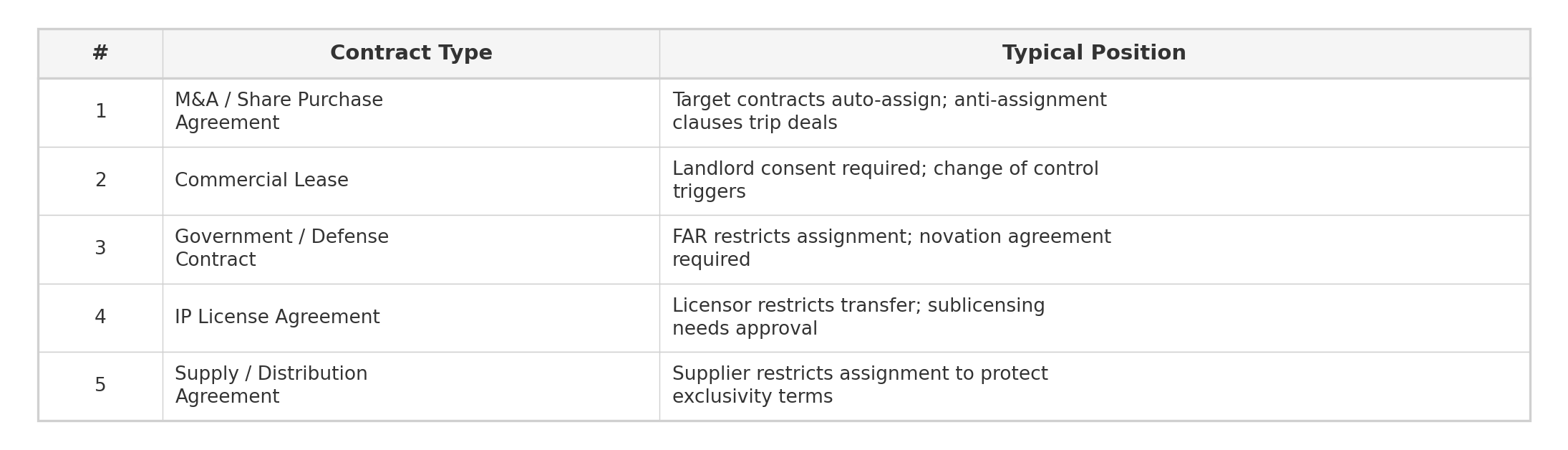
Contract types where Assignment Clause is critical:
Common structures and market practices:
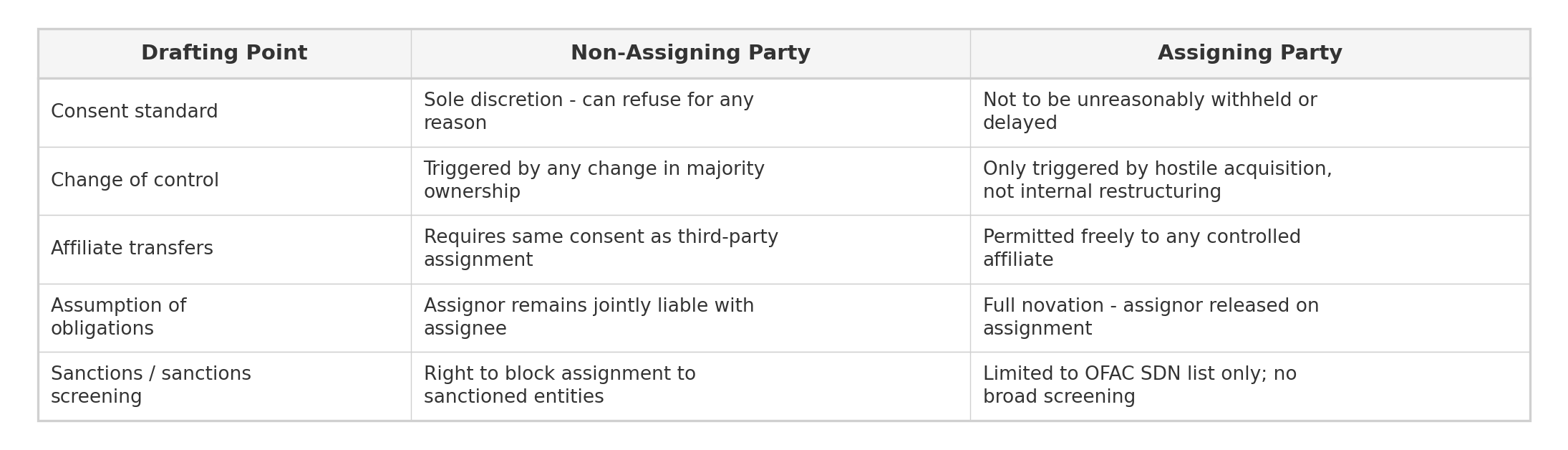
Negotiation Playbook
Key Drafting Notes
- Map assignment to deal structure early: Before drafting, identify whether the contract is likely to be part of a future M&A transaction, PE rollup, or financing arrangement. If the answer is yes, build in affiliate and financing carve-outs from the start rather than renegotiating later when leverage shifts.
- Define "affiliate" with precision: Use a specific ownership threshold (e.g., "directly or indirectly owns or controls at least 50% of voting equity") rather than vague terms like "related entity." Ambiguous affiliate definitions are among the most litigated assignment issues in PE transactions.
- Pair consent standards with deemed-consent timelines: If using "consent not to be unreasonably withheld," add a deemed-consent fallback (e.g., 30 days). Without a timeline, the counterparty can delay indefinitely, effectively converting a "reasonable consent" standard into an absolute veto.
- Address assignment by operation of law separately: Mergers, statutory conversions, and certain bankruptcy transfers operate by law regardless of contractual restrictions. Include a clause specifying whether these events trigger assignment consent requirements, or whether they are carved out entirely.
- Include a termination right as the counterparty's backstop: If you cannot negotiate an absolute prohibition, secure a termination right triggered by assignment or change of control. This gives the counterparty meaningful protection without blocking the transaction outright, and it creates leverage for renegotiating terms with the new assignee.
Common Pitfalls
- Burying assignment in Miscellaneous: Assignment clauses hidden in boilerplate sections are routinely missed during due diligence. A single overlooked anti-assignment provision in a key customer or supplier contract can delay or derail an acquisition. Flag assignment provisions in the contract summary and ensure they are reviewed during any deal process.
- Confusing assignment with novation: Assignment transfers rights (and sometimes duties), but the original party may remain liable. Novation substitutes a new party entirely, releasing the original. Many drafters use "assignment" when they mean novation, creating confusion about whether the original party retains liability post-transfer.
- Failing to address indirect change of control: A narrow change of control definition (e.g., "transfer of 50% of equity") can be circumvented through layered holding structures. A PE fund can transfer control of a portfolio company by selling the fund vehicle itself without triggering a contract-level change of control clause. Use language that captures both direct and indirect transfers of control.
- Overlooking the interplay with IP licenses: Many commercial agreements contain embedded IP licenses (software, trademarks, patents) that have their own assignability rules. An assignment clause that permits transfer of the commercial agreement may not automatically transfer the embedded IP rights, leaving the assignee without the licenses needed to perform.
- Ignoring lender collateral assignment requirements: Financing lenders routinely require borrowers to assign contract rights as collateral. If the underlying contract prohibits assignment, the lender's security interest may be unenforceable. Include a carve-out for collateral assignments to financing lenders, or risk creating a conflict between the loan agreement and the commercial contract.
Key drafting notes for an Assignment Clause:
- M&A Trap: Do not bury assignment restrictions in a "change of control" clause in Miscellaneous. Buyers in due diligence should identify critical contracts with broad consent requirements or change of control triggers. A single supplier contract with "no assignment without consent" can block a $500M deal if the supplier is hostile or demands consideration for consent.
- Affiliate Definition: If you allow affiliate assignment, define "affiliate" clearly. Does it mean subsidiary (ownership >50%), parent, or any entity under common control? Vague language leads to disputes when a holding company tries to assign to a distant subsidiary. Use: "Affiliate means any entity in which the assigning party directly or indirectly owns or controls at least 50% of voting equity."
- FAR Sensitivity: Government contracts incorporate FAR clause 52.229-1 or similar, which requires that key performance obligations remain with the contractor named in the agreement. You cannot assign to a subcontractor and escape personal responsibility. If your company wins a federal contract, do not assume you can easily subcontract to a lower-cost provider without government approval - the contract is non-assignable without novation.
- Bankruptcy Wildcard: Even if a contract prohibits assignment, a bankruptcy debtor under Section 365 can assume the contract (with counterparty consent) and assign to a buyer. Conversely, a nonassignable contract (personal services, exclusive license) cannot be assigned even in bankruptcy. If you are the counterparty to a distressed borrower's supplier, push for non-assignability language tied to personal performance or exclusive rights to limit bankruptcy exposure.
- Sanctions and Cross-Border Risk: In cross-border deals, do not assume written consent to assignment covers sanctions exposure. If your contract prohibits assignment to "any entity, including sanctioned entities," and OFAC designates the intended assignee mid-deal, consent becomes legally moot. Consider conditional language: "Assignment is permitted provided that the assignee is not subject to OFAC, EU, or other applicable sanctions; if assignee becomes sanctioned post-assignment, either party may terminate without liability."
Historic note:
The common law rule (Restatement (Second) of Contracts) held that contract rights are assignable by default unless assignment would materially alter the other party's performance obligations or expectations. This default made commercial sense: contracts should be tradeable assets. However, modern commercial practice inverted this by inserting explicit restrictions, especially in IP and financial contracts. The Uniform Commercial Code (UCC 2-210) tried to recalibrate: goods sales are assignable by default, but assignment can be barred by agreement. This tension - default assignability vs. contractual restriction - remains unresolved in non-UCC domains (services, IP, financial derivatives). Courts now tend to honor explicit restrictions even when harsh, reasoning that sophisticated parties bargained knowingly.
Jurisdiction specific notes:
- U.S. Common Law: Courts generally enforce anti-assignment provisions as written, especially if parties are sophisticated. The Restatement rule allowing default assignability has been eroded by explicit contractual language. Bankruptcy courts apply Section 365 rigorously: non-assignable contracts (personal services, exclusive licenses, contracts with anti-assignment clauses) cannot be assigned by the debtor in Chapter 11, even with counterparty consent. UCC Article 9 (Secured Transactions) allows security interests in contract rights even if the underlying contract restricts assignment, creating a loophole for lender collateral.
- U.K. Law: English courts follow similar common law principles but are more willing to find implied consent or override restrictions under good faith and fairness. The concept of "equitable assignment" allows assignment of some contract rights even if the contract restricts it, though this is narrow. Statutory protections (e.g., Late Payment of Commercial Debts Act 1998) limit assignment restrictions on payment obligations in certain commercial contracts. Insolvency law (U.K. Insolvency Act 1986) parallels U.S. bankruptcy for Section 365 analogs.
Drafting Tip - Global Deals:
In international contracts, assignment language often varies by governing law. A contract governed by English law may be more amenable to equitable assignment than one under New York law. If governing law is disputed (e.g., English law governs but venue is New York), anticipate conflicts. Best practice: in cross-border deals, use parallel assignment language that tracks restrictiveness under both laws. Example: "Assignment is not permitted except to permitted assignees (as defined herein), which restriction shall be enforceable to the maximum extent permitted by applicable law, including any equitable assignment doctrine."
.avif)