TL;DR:The notice clause is boring until it matters, then it matters enormously. A failure to send notice via the right method can void your termination right, restart a cure period, or forfeit an indemnity claim. In 2025-26, with email as the default and Slack/Teams notifications as emerging methods, refresh your notice clauses to explicitly accept electronic delivery. For high-stakes notices (termination, material breach, claims exceeding thresholds), specify backup methods: email plus registered mail, or email plus courier. For routine notices (address changes, administrative updates), email alone is fine. Define deemed receipt clearly - 3 days after mailing is a useful fiction for mail-based proof, but switch to actual receipt (read receipt, courier signature) for email to speed decision-making. Avoid dual receipt rules that create ambiguity. Require address updates within 30 days of organizational change to prevent stale-address loopholes. In international deals, always specify time zones and define business hours in the recipient's zone. Courts will enforce notice requirements as written, so drafting with precision here pays dividends when disputes arise.
What is a Notice Clause?
Notice clauses embed hidden complexity. Most contracts require notice for termination, default, amendments, and election of remedies. Fail to give proper notice, and you lose rights - courts do not forgive technicalities. But what is "proper"? Email sent at 11pm on Friday to an address that bounces? Notice delivered to a contact who quit three months ago? In international deals, which time zone applies for "business day" calculations? The 2025-26 shift to hybrid work and asynchronous communication has made the traditional "business hours" default obsolete, yet many contracts cling to it.
The core friction lies in certainty of receipt. Registered mail creates a paper trail and deemed receipt rule - if you mail it, you can prove timing. Email is instant and convenient but creates evidentiary gaps: Did they actually read it? Was it in spam? Did the email address change? COVID accelerated electronic notice adoption. UETA and the federal E-SIGN Act both recognize electronic signatures and notices, but they require "consent" to electronic delivery - meaning a counterparty can claim they did not consent to email-only notice. Blockchain and digital timestamps are gradually becoming proof of delivery, but most contracts have not caught up to this technology.
Notice clauses also reveal trust issues embedded in the relationship. Conservative parties demand registered mail + email + legal counsel notification. Aggressive parties push "email to any address you have on file is sufficient." This reflects underlying concerns: Is the counterparty likely to claim they never got your termination notice? Are they dishonest? A well-drafted clause balances speed (email) with proof (deemed receipt rule) and accommodates modern delivery (electronic portal, Slack, etc.) while preserving formality for high-stakes notices (termination for cause, force majeure, default remedies).
• Email has become the default notice method, but many contracts still require registered mail, creating compliance traps
• Deemed receipt rules (notice effective 3 days after mailing) create fiction when parties actually have different information
• Multiple addresses and copies to counsel multiply compliance burden; missing one party voids the notice
• Business hours and time zone calculations trip up international deals; asynchronous work makes "business hours" ambiguous
• Defective notice (wrong address, method, timing) often voids entire notice and resets cure periods, wiping out termination rights
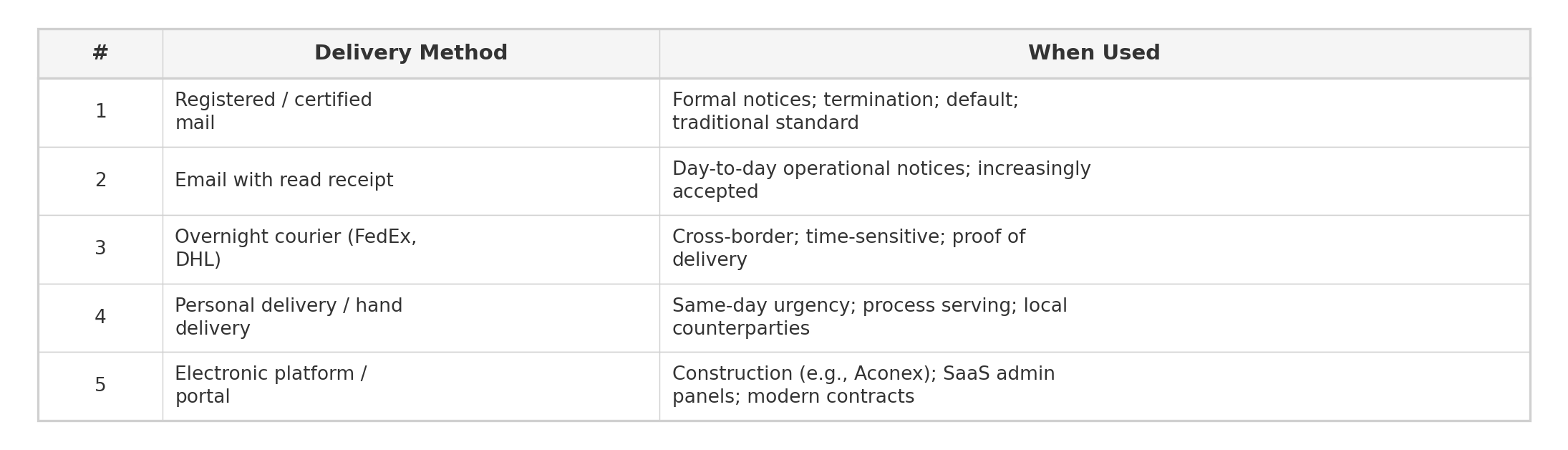
Notice Methods and Delivery Mechanics
- Hand Delivery (Personal Service): Notice hand-delivered to recipient or authorized representative. Most reliable; effective immediately upon receipt. Risk: finding the right person and proving delivery. In offices, reception desk acceptance may not count as notice to the party. Best practice: confirm contact person's name and title.
- Registered Mail / Certified Mail: Standard business method. Sender gets receipt; U.S. Postal Service creates chain of custody. Deemed received on third business day after mailing, even if recipient was absent. Burden on recipient to claim they did not receive (tough). Still gold standard for high-stakes notices (default, termination) despite slower speed.
- Email (Modern, Fastest): Sent to designated email address. Challenges: bounce-backs may not be visible, emails land in spam, "read receipt" is not proof of actual review. Many contracts now accept email but add conditions: sent during business hours, to specified address, with read receipt or confirmation. UETA and E-SIGN require "consent" to electronic delivery - contract must explicitly authorize email to avoid later claims of insufficient notice.
- Courier / Overnight Delivery (FedEx, UPS): Fast, traceable, signed for. Effective when recipient signs. Risk: recipient not available; signature by anyone at address may not be sufficient. Usually treated as equivalent to personal delivery. Costs more than mail but faster than certified mail.
- Secure Portal / Dashboard Notice: Increasingly common in digital-first contracts (SaaS, financial platforms). Notice posted to password-protected portal; recipient must have access. Ambiguity: is posting = notice received, or must recipient actually read? Best practice: add email alert when notice is posted, treating portal as supplement to email.
Deemed Receipt and the Timing Problem
- Deemed Receipt Fiction: Contracts often state "notice mailed via registered mail shall be effective 3 business days after mailing, regardless of actual receipt." This benefits the sender (you do not have to prove delivery) but may hurt if the recipient was legitimately out of office. The rule assumes mail is reliably delivered within 3 days, which was reasonable in 1990 but questionable now. Courts enforce it as written, even if harsh.
- Business Day and Time Zone Ambiguity: What is a "business day"? For a party in New York, does 5pm Friday notice count as "same business day" for a recipient in Tokyo (same day is already tomorrow there)? Most contracts define business day as Monday-Friday, excluding holidays, in the recipient's time zone - but if recipient is a multinational, which time zone? Add "notice effective on next business day if sent after 5pm" for email, creating a timing cushion.
- Actual Knowledge vs. Deemed Receipt: Some contracts include language: "Notice is effective when actually received by recipient or when deemed received under this clause, whichever is earlier." This can backfire: if you email notice at 4:55pm Friday with "deemed receipt" language, the other party can claim they got it and cure period started immediately, even though "business hours" had just ended. Avoid this trap by specifying a single receipt rule: either actual receipt, or deemed receipt, not both.
- Addresses and Updates: Contracts list initial notice addresses. But what if a party moves and does not update its address? Notice sent to the old address may be "effective" under the deemed receipt rule even though recipient never got it. Best practice: require parties to update notice addresses within 10 days of change. If address not updated, notice to last known address is effective, making it the updating party's burden.
- Multiple Recipients - Stranded Notice: Contracts often require notice to "Party A, its legal counsel, and its financial officer at the addresses listed." If you forget to send to counsel, is the notice valid? Contracts vary: some require notice to ALL listed parties (strict); others require notice to at least one (flexible). The strict approach protects the recipient (more oversight, more likely to notice) but creates compliance burden on the sender. Clarify in drafting: "Notice is effective when sent to all listed addresses" or "Notice is effective when sent to any of the following."
A well-drafted Notice Clause contains:
- Explicit Acceptance of Email and Electronic Notice: State clearly that email is acceptable. Example: "Any notice required hereunder may be delivered (a) in person, (b) via email to the email addresses specified below, (c) via overnight courier, or (d) via registered or certified mail, postage prepaid." This avoids later claims that email was not authorized under UETA/E-SIGN. If electronic signature requirements apply, reference them explicitly: "Electronic notices shall comply with UETA (15 U.S.C. 7001 et seq.) and shall be deemed received when transmitted, provided they are sent to designated addresses below."
- Recipient Address(es) and Update Mechanism: List the party's notice address, email, and if applicable, legal counsel contact. Include a process for updates: "Each party may change its notice address by written notice to the other party, effective 10 business days after notice of change. Notices sent before the 10-day period expires remain valid if sent to the prior address." This prevents the "moved without telling you" loophole where someone claims notice was ineffective because you sent to an outdated address.
- Deemed Receipt Rule and Timing: Specify when notice is effective. Example: "Notice via email is effective upon transmission if sent during business hours (8am-5pm, recipient's time zone), or at the start of the next business day if sent outside business hours. Notice via registered mail is effective 3 business days after mailing. Notice by courier is effective upon signed receipt." Avoid dual receipt rules ("actual or deemed") which create ambiguity. Pick one and stick with it.
- Business Hours Definition: Define "business hours" and "business day" to avoid time zone confusion. Example: "Business hours means 8:00am to 5:00pm, Monday through Friday, excluding U.S. Federal holidays, in the recipient party's principal place of business. Business day means any Monday through Friday that is not a holiday." This removes guesswork for international parties.
- Legal Formalities for High-Stakes Notices: For termination, default, or indemnity claims, specify extra formality. Example: "Notices of termination, material breach, or indemnity claim must be delivered via (a) hand delivery with proof of receipt, or (b) registered mail with return receipt requested. Email notice is not sufficient for these notices." This protects both parties by making sure important notices are not missed due to spam filters or oversight.
- Copies to Legal Counsel (Optional): Specify whether copies must be sent to counsel. Example: "All notices shall be sent to the parties' addresses above and, if legal proceedings are anticipated, to counsel at the addresses listed in Exhibit A." This creates redundancy for disputes. However, be careful: if you require copies to counsel for all notices, you impose cost and complexity. Reserve this for serious notices only.
- Defective Notice and Waiver: Address what happens if notice is sent to the wrong address or method. Example: "Failure to follow the notice requirements of this clause shall not invalidate notice if the receiving party actually receives the communication and has actual knowledge of its contents. However, the sending party bears the burden of proving actual receipt. Any delay caused by defective notice is the responsibility of the sending party." This allows courts to apply common sense (if they got it, they got it) while protecting the receiving party.
Market Position & Benchmarks
Where Does Your Clause Fall?
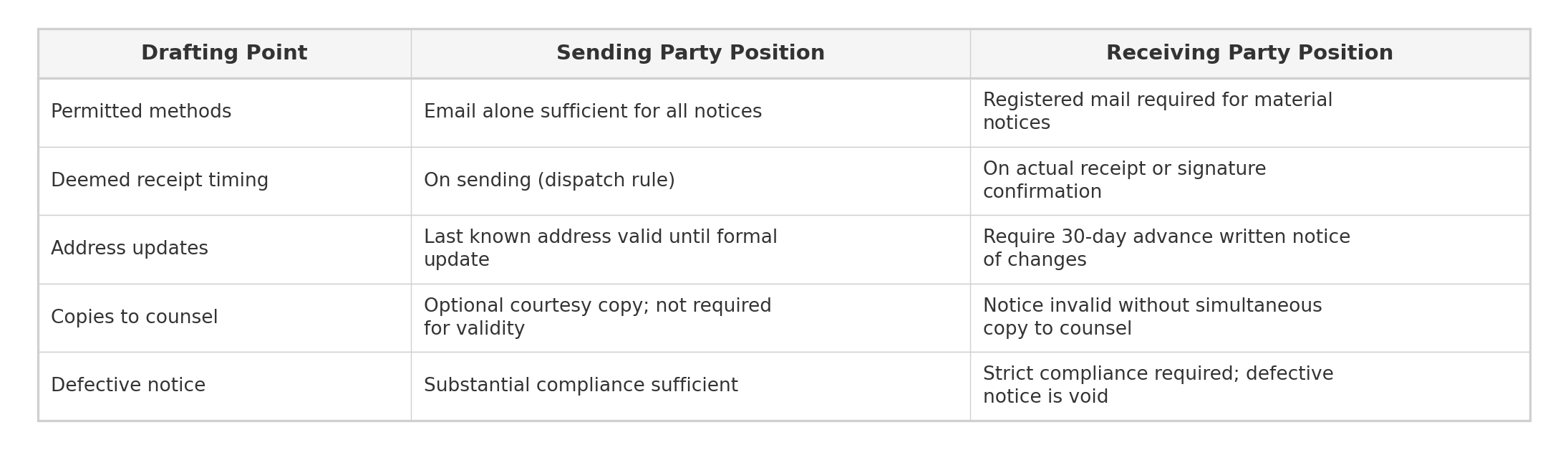
- Receiver-Protective (Strict Formality): Requires registered mail or hand delivery for all notices; email is not accepted. Multiple recipients required (party, legal counsel, and financial officer). Notice only effective upon actual receipt or signed confirmation. No defective notice waiver. Strict compliance is mandatory; failure to follow any requirement voids the notice entirely. This position maximizes the recipient's ability to challenge defective notices and preserves cure periods.
- Balanced/Market Standard: Email accepted for routine notices; registered mail or courier required for high-stakes notices (termination, default, indemnity claims). Deemed receipt rule: email effective upon transmission during business hours; mail effective 3 business days after posting. Addresses updated within 10 business days of change. Defective notice waived if recipient has actual knowledge. One primary recipient per party; copies to counsel optional for material notices.
- Sender-Protective (Maximum Flexibility): Email to any known address is sufficient for all notice types, including termination. No backup method required. Deemed receipt upon transmission regardless of business hours. No obligation to confirm receipt or obtain read receipts. Notice to any officer, director, or manager constitutes valid notice. Defective notice waived if sent to any address on file. Minimal compliance burden on the sending party.
Market Data
- Approximately 82% of commercial contracts signed after 2023 explicitly accept email as a valid notice method, up from 55% in 2018. However, only 48% accept email as the sole method for termination notices (WorldCC Contract Terms Survey, 2024).
- The most common deemed receipt period for registered mail is 3 business days (used in approximately 60% of contracts). For international mail, 5-7 business days is standard, appearing in 70% of cross-border agreements.
- Roughly 65% of enterprise contracts require notice to multiple recipients (primary contact plus legal counsel). In M&A agreements, the figure rises to 90%, reflecting the higher stakes of deal-related communications.
- Address update requirements appear in 72% of negotiated contracts, with the most common update window being 10 business days (45% of contracts) followed by 30 calendar days (30%).
- Defective notice waiver provisions ("notice is valid if recipient has actual knowledge") appear in approximately 55% of U.S. commercial contracts but only 35% of U.K. contracts, reflecting English courts' stricter approach to contractual compliance.
- Portal-based notice (posting to a secure platform with email alert) is now accepted in 28% of SaaS and financial services contracts, up from 8% in 2020.
Sample Language by Position
Receiver-Protective: "All notices, demands, and communications required or permitted under this Agreement shall be in writing and shall be effective only when: (a) delivered by hand to a responsible officer of the receiving Party, with written acknowledgment of receipt; or (b) sent via registered or certified mail, return receipt requested, to the addresses specified in Schedule A. Notices sent by email, facsimile, or other electronic means are not effective under this Agreement. Notice is effective upon actual receipt, as evidenced by signed acknowledgment or postal return receipt. Each notice must be sent simultaneously to the Party and to its legal counsel at the addresses listed. Failure to send to all listed recipients renders the notice void."
Balanced/Market Standard: "Any notice required under this Agreement shall be in writing and delivered by: (a) email to the addresses specified below (effective upon transmission during business hours, or at the start of the next business day if sent after 5:00 pm in the recipient's time zone); (b) nationally recognized overnight courier (effective upon signed receipt); or (c) registered or certified mail, postage prepaid (effective 3 business days after mailing). Notices of termination, material breach, or indemnity claims must be sent via methods (b) or (c), with a courtesy copy by email. Each Party may update its notice address by written notice effective 10 business days after receipt. Failure to comply strictly with this clause shall not invalidate notice if the receiving Party has actual knowledge of the communication's contents."
Sender-Protective: "Notices may be delivered by email, courier, registered mail, or hand delivery to any address the sending Party reasonably believes to be current for the receiving Party. Email notice is effective upon transmission, regardless of whether sent during business hours. Delivery to any officer, director, general counsel, or contract administrator of the receiving Party constitutes valid notice to the Party. If an email bounces or is undeliverable, the sending Party has no further notice obligation unless it has actual knowledge of an alternative address. A notice that does not strictly comply with this clause is nonetheless effective if the receiving Party received it and understood its contents."
Example language:
Two versions reflecting different risk allocation:
- Strict/Conservative (Receiver-Protective): "All notices, demands, and requests required or permitted under this agreement must be in writing and shall be effective only if delivered personally, sent via overnight courier with signature required, or sent via registered mail, return receipt requested, to the addresses specified below. Notices by email are not effective unless specifically agreed in writing. Notices by registered mail shall be deemed effective 3 business days after mailing."
Example: "All notices required or permitted hereunder must be in writing and shall be effective when (a) delivered in person to a responsible officer of the party, (b) sent via email to the notice address below with read receipt requested (effective upon transmission during business hours or the next business day if after 5pm), or (c) sent via registered or certified mail, postage prepaid, return receipt requested, to the address below (effective 3 business days after mailing, regardless of actual receipt). Each party may change its notice address by written notice to the other party, effective 10 days after receipt of such notice. Notices of termination, material breach, or default must be sent via methods (a) or (c) above; email notice alone is insufficient for such notices."
- Flexible/Modern (Sender-Protective): "Any notice required hereunder may be delivered (a) via email, with read receipt requested (effective upon transmission), (b) via personal delivery (effective upon receipt), (c) via courier (effective upon signed receipt), or (d) via registered mail (effective 3 business days after mailing). If email delivery fails or bounces, sender has no further notice obligation unless sender has actual knowledge of an alternative email address. Sending notice to any party officer, manager, or general counsel at any address listed below constitutes valid notice."
Example: "Notices shall be delivered to the addresses below via (i) hand delivery, (ii) email during business hours (8am-5pm EST, Monday-Friday), (iii) courier, or (iv) registered mail. Notice via email is effective upon transmission if sent during business hours, or at 8am the next business day if sent after 5pm. Notice via registered mail is effective 3 business days after mailing. Regardless of method, if a party actually receives notice and has knowledge of its contents, notice is effective even if this clause was not strictly followed. However, the sending party remains responsible for defects in notice delivery, and no cure period runs unless proper notice is given."
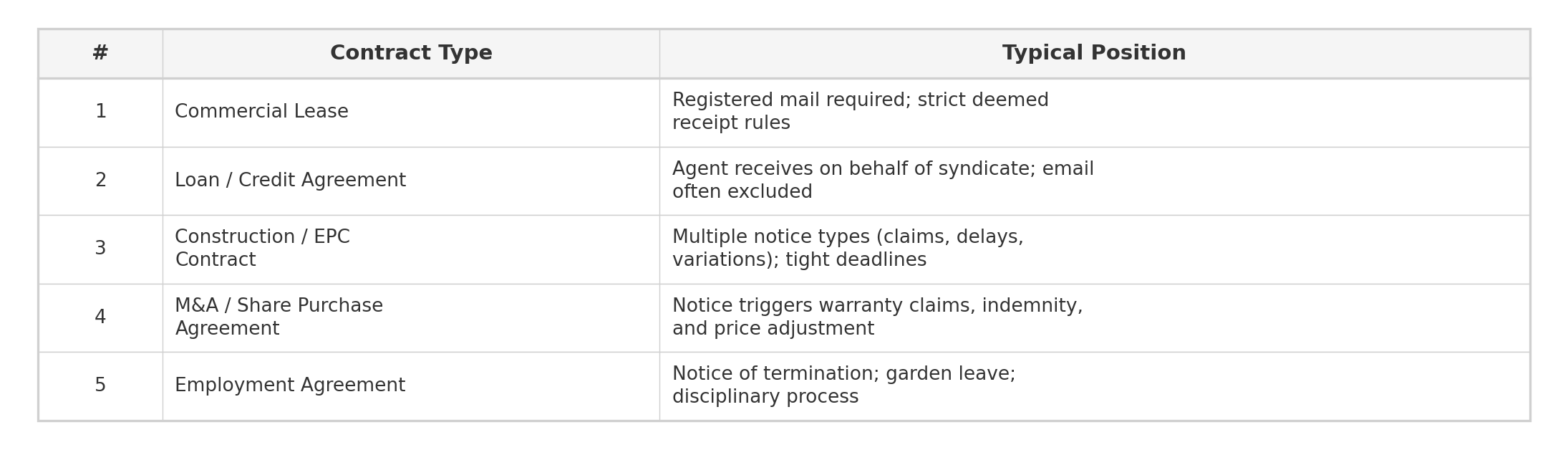
Contract types where Notice Clause is critical:
Common structures and market practices:
Negotiation Playbook
Key Drafting Notes
- Differentiate Notice Requirements by Purpose: Not all notices carry the same weight. Routine administrative notices (address changes, contact updates, invoice submissions) should have minimal formality: email to the designated address is sufficient. Material notices (termination, default, indemnity claims, force majeure invocations) require enhanced formality: email plus registered mail or courier, with copies to legal counsel. Drafting a single notice mechanism for all purposes either over-burdens routine communications or under-protects critical ones. Use a tiered structure that specifies which method applies to which type of notice.
- Set a Hard Deadline for Address Updates: Stale addresses are the most common source of notice disputes. Require each party to update its notice address within 10 business days of any change (office relocation, M&A closing, key personnel departure). Specify that notices sent to the last known address remain effective if the party failed to provide an update. This shifts the burden to the party that moved or restructured, preventing opportunistic claims of "we never received it" from a company that simply failed to update its contact information.
- Define "Business Hours" and "Business Day" With Precision: In international contracts, vague references to "business hours" create disputes. Define business hours as 8:00 am to 5:00 pm in the recipient's principal place of business, Monday through Friday, excluding public holidays in that jurisdiction. For deemed receipt of email, specify: sent during business hours = effective upon transmission; sent outside business hours = effective at the start of the next business day. This removes ambiguity when parties operate in different time zones.
- Use a Single Receipt Rule, Not a Hybrid: Avoid clauses that say "notice is effective when actually received or when deemed received, whichever is earlier." This creates conflicting start dates for cure periods and response deadlines. If the recipient opens an email on Monday but the registered mail version arrives (deemed received) on Wednesday, when did the clock start? Pick one rule per method: email = effective on transmission during business hours; registered mail = effective 3 business days after posting; courier = effective on signed receipt. Do not combine actual and deemed receipt for the same notice.
- Address the "Copies to Counsel" Trap Carefully: Requiring copies to legal counsel for all notices adds cost and complexity. Worse, if the clause says notice is only effective when received by "all" listed recipients, missing the counsel copy voids the notice entirely, even if the party itself received and read it. Limit counsel copies to material notices only (termination, breach, indemnity). For all other notices, state: "Copies to counsel are courtesy copies; failure to provide a counsel copy does not invalidate notice to the Party."
Common Pitfalls
- Email-Only Notice for Termination in Jurisdictions That Require Writing: While email qualifies as "writing" under UETA and E-SIGN in the U.S. and under the e-Commerce Regulations 2002 in the U.K., some contracts (especially those governed by civil law jurisdictions) may require "written notice" to mean a physical, signed document. If your contract is governed by a jurisdiction where email may not satisfy "writing" requirements (e.g., certain Middle Eastern or Asian jurisdictions), relying on email alone for termination notice could void your termination right. Always check the governing law's requirements and specify backup methods for high-stakes notices.
- No Consequence for Defective Notice: Many notice clauses describe what proper notice looks like but do not state what happens when notice is defective. Does defective notice restart the cure period? Does it void the termination entirely? Without an explicit consequence, courts will decide, and outcomes vary. Best practice: state that defective notice delays the effective date of the notice until proper notice is given, but does not waive the sender's right to re-send. Alternatively, include an "actual knowledge" savings clause: "Defective notice is nonetheless effective if the receiving Party has actual knowledge of the notice contents, provided the sending Party proves actual knowledge."
- Deemed Receipt Rules That Outrun Reality: A "3 business days after mailing" deemed receipt rule was calibrated for domestic postal systems in the 1980s and 1990s. For international mail, 3 days is unrealistic; 7-10 business days is more appropriate. If your contract involves parties in different countries and uses a domestic deemed receipt window for international mail, the recipient may not actually receive the notice until well after it is "deemed" received, compressing or eliminating their cure period. Match the deemed receipt period to the actual delivery speed of the method specified.
- Ignoring Organizational Changes (M&A, Restructuring): When a party is acquired, merged, or restructured, notice addresses become immediately stale. If the contract does not address what happens to notice obligations during organizational changes, the sending party may send termination notice to a defunct entity at a closed office. Include language requiring the surviving or acquiring entity to provide updated notice addresses within 30 days of closing. Notices sent to the prior address before the update remain valid.
- Portal-Only Notice Without Email Backup: Some SaaS contracts specify that all notices are delivered by posting to a secure customer portal. This is efficient but risky: if the customer does not log in regularly, they may not see a termination or default notice for weeks. Always pair portal notice with an email alert notifying the recipient that a notice has been posted. Specify that portal notice is effective upon posting only if the email alert was sent simultaneously. Without this backup, a court may find that posting to a portal the customer never checked was not reasonable notice.
Key drafting notes for a Notice Clause:
- Email Acceptance is Now Essential: If your contract does not explicitly accept email as a valid notice method, you are operating in a 1995 mindset. Courts increasingly treat email as valid, and UETA/E-SIGN presume electronic delivery is okay unless parties agree otherwise. The risk is the reverse: if you insist on registered mail only and the other party claims they sent email, you may face arguments that you waived strict compliance. Modern contracts should list email first, then alternatives. This accelerates cure periods and reduces disputes.
- Avoid Deemed Receipt Rules for Time-Sensitive Decisions: Deemed receipt (effective 3 days after mailing) works for non-critical notices but creates problems for default cure periods. If your contract says "cure within 10 days of notice" and notice is via registered mail with 3-day deemed receipt, the receiver does not actually know they are in default until day 5-6, leaving only 4-5 days to cure. For default notices, switch to email with read receipt or hand delivery - speed matters. For routine notices (addresses, administrative updates), deemed receipt is fine.
- Define Business Hours in International Deals: A party in Singapore and a party in London have no overlapping business hours. If you require "notice during business hours," it is effectively impossible. Either define business hours in the recipient's time zone (what most contracts do), or allow email at any time and only add the "business hours" rule for interpretation of when notice is "received" (i.e., if sent outside hours, effective next business day). This prevents unfair race conditions.
- Single Receipt Rule, Not Dual: Avoid "notice is effective when actually received or deemed received, whichever is earlier." This creates disputes. If you receive an email at 10am and the contract has "deemed receipt on 3rd day after mailing," and the email was the backup to the registered mail, when did notice actually take effect? Did the cure period start at 10am (email) or day 3 (mail)? Pick one rule: either actual receipt (email, courier), or deemed receipt (mail), and be consistent. If you have both methods, state: "notice by email is effective on receipt; notice by mail is effective on [3rd] day after mailing; sender may use either method."
- Addresses and Organizational Changes - Update Protocols Matter: Companies merge, restructure, and move. Notice addresses become stale. Address this in the clause: "If a party is acquired, the acquiring company's notice address is effective 30 days after closing unless acquiring company gives prior written notice of an alternative address. Notices sent to the prior address remain valid if sent prior to the change date." This prevents the scenario where Company A is acquired by Holdco B, and six months later Holdco B claims it never got notice of default because the old address was invalid.
Historic note:
Pre-internet, notice clauses were about mail reliability and telegraph speed. Registered mail became the gold standard because the Post Office created a traceable record. The Uniform Commercial Code (UCC 1-202) codified "reasonable notice" - oral notice was sufficient in some contexts, written was better. When fax arrived in the 1980s-90s, contracts began accepting "fax to the number specified," with receipt confirmed by fax handshake (tone confirming page received). Email arrived and broke this model - no handshake, no universal read receipt standard, spam filters invented. Legal doctrine (UETA, E-SIGN in 2000) tried to catch up by saying electronic notice is valid if the receiving party consented. But "consent" in a contract signed three years ago, buried in boilerplate, created disputes: Did we really consent to email notice, or just email communications generally? Modern practice accepts email by default and requires explicit opt-out, which is a philosophical shift from the pre-digital era.
Jurisdiction specific notes:
- U.S. Common Law and UCC: Under UCC 1-202, notice is effective when received or when the recipient should have received it (constructive receipt). This is flexible. However, parties can and do impose stricter requirements by contract. If your contract says "notice via registered mail only," courts enforce it, even if email would have been faster and clearer. Federal law (UETA, 15 U.S.C. 7001-7031) provides a safe harbor: electronic notices are valid if parties have agreed and recipient has access. The burden is on the drafter to document consent clearly. State variations exist (some states narrower on electronic notice), so uniform language across jurisdictions is best.
- U.K. Law: U.K. contract law does not require written notice for all matters; oral notice can be sufficient. However, disputes and formal terminations should be documented in writing. The U.K. tends toward practical receipt: if notice was sent and the recipient could reasonably have received it, courts presume receipt. Email is accepted by convention and by statute (e-Commerce Regulations 2002) for most B2B notices. Registered mail is less common in the U.K. than in the U.S.; courier and email dominate. Time zones are less of an issue (single jurisdiction, same time). The U.K. courts are skeptical of overly technical notice requirements and may find strict compliance waived if the recipient had actual knowledge despite defective notice.
Drafting Tip - Global Deals:
For multinational contracts, specify (1) that electronic notice (email) is acceptable and complies with UETA, E-SIGN, and eIDAS (EU electronic signature directive), (2) that business hours are in the recipient's time zone, (3) that for critical notices (termination, claims exceeding $1M), backup methods are required (email + registered mail), (4) that notice addresses are updated within 30 days of organizational change, and (5) that time zone delays do not excuse compliance (if you are in Los Angeles and the recipient is in Singapore, that is your problem, not theirs). This prevents disputes where one party claims "email was not valid in my jurisdiction" or "I was in a different time zone so the deadline did not apply."
.avif)